

The Financial Risk Manager (FRM) certification covers a lot of key concepts: in this article we will talk about the FRM syllabus. For quant developers, it provides a useful framework for understanding the financial models, products, and risk measures that sit behind many real-world systems.
This guide looks at the FRM from a quant developer’s perspective: which topics matter most, how they connect to real development work, and where C++ projects can help turn theory into practical skills.
1. Why Should a Quant Developer Care About the FRM?
Quant developers are usually hired for their programming ability, mathematical background, and understanding of financial markets. In practice, however, writing good C++ or Python is only part of the job. A developer working on pricing, risk, trading, or portfolio systems also needs to understand what the numbers being calculated actually mean.
This is where the Financial Risk Manager (FRM) curriculum can be useful.
The FRM is not a programming qualification, and it will not teach you how to write high-performance C++, design a pricing library, or optimise a Monte Carlo engine. What it does provide is a structured introduction to many of the financial concepts that quant developers encounter in banks, hedge funds, asset managers, and other financial institutions.
Topics such as derivatives, fixed income, probability, statistics, Value at Risk, Expected Shortfall, market risk, credit risk, counterparty exposure, and stress testing are all directly related to systems that quant developers may eventually be asked to build or maintain.
For example, it is one thing to implement a function that calculates VaR. It is another to understand why the calculation is being performed, what assumptions sit behind it, how the result should be interpreted, and where the model can fail.
That domain knowledge becomes particularly valuable when working closely with quantitative analysts, traders, risk managers, and model validation teams.
For a quant developer, the real value of the FRM syllabus is therefore not necessarily the certification itself. It is the financial and risk-management knowledge behind it.
2. FRM 2026 Syllabus at a Glance
How is the FRM exact structured?
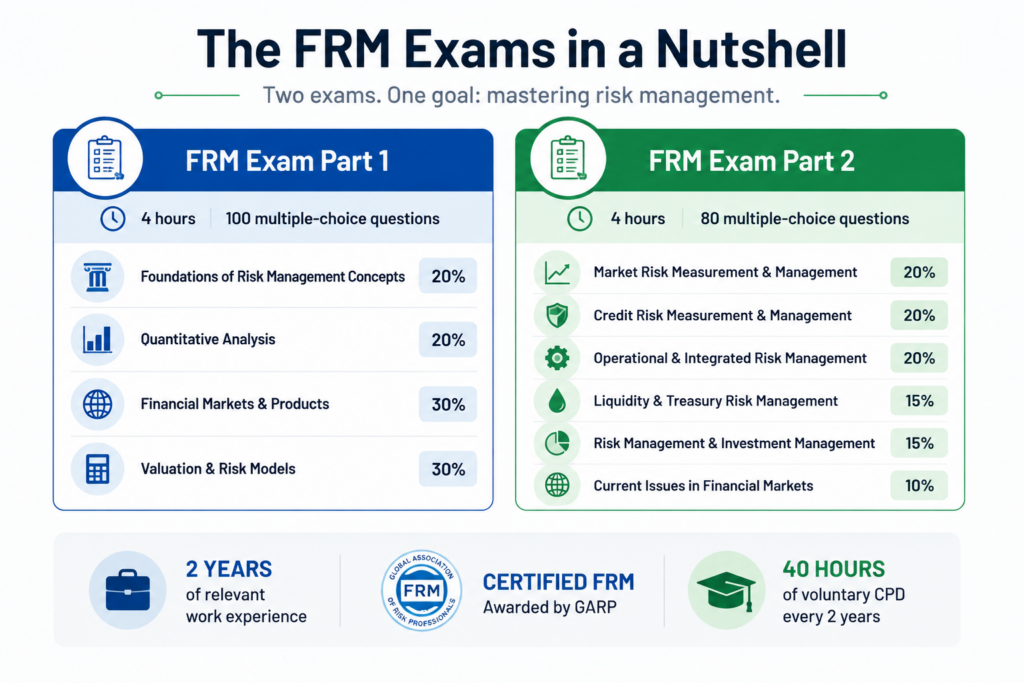
FRM Part I
FRM Part I focuses on the fundamental tools used to understand and measure financial risk.
The four main areas are:
- Foundations of Risk Management
- Quantitative Analysis
- Financial Markets and Products
- Valuation and Risk Models
For quant developers, Part I is especially relevant because it covers many of the concepts that appear in quantitative libraries and risk systems, including:
- Probability and statistics
- Regression and time-series analysis
- Derivatives and fixed-income products
- Valuation techniques
- Volatility and correlations
- Value at Risk (VaR)
- Expected Shortfall
- Monte Carlo methods
- Risk factors and sensitivities
In many ways, Part I provides the mathematical and financial foundations needed to understand what a quantitative system is actually calculating.
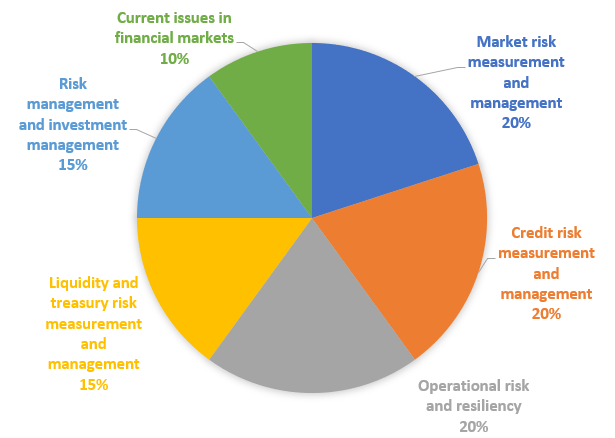
FRM Part II
FRM Part II builds on those foundations and focuses more heavily on applying them to real-world risk management.
The main areas are:
- Market Risk Measurement and Management
- Credit Risk Measurement and Management
- Operational Risk and Resilience
- Liquidity and Treasury Risk Measurement and Management
- Risk Management and Investment Management
- Current Issues in Financial Markets
From a quant developer’s perspective, the most directly relevant topics include:
- Market risk measurement
- Scenario analysis
- Stress testing
- Value at Risk and Expected Shortfall
- Credit risk modelling
- Counterparty exposure
- Probability of default and loss given default
- Liquidity risk
- Portfolio risk
- Risk aggregation
Part II is closer to the type of work found in production risk infrastructure, where the goal is not simply to value one instrument, but to measure risk across portfolios, counterparties, and changing market conditions.
3. FRM Part I: What Matters to Quant Developers?
FRM Part I is probably the most immediately useful part of the curriculum for a quant developer. It introduces the quantitative tools, financial instruments, valuation techniques, and risk concepts that sit behind many pricing and risk systems.
Some areas have a much stronger connection to quant development than others. Let’s look at each one of the FRM syllabus part 1.
3.1 Quantitative Analysis
Relevance for Quant Developers: ★★★★★
Quantitative Analysis covers much of the mathematical and statistical foundation used throughout quantitative finance. Topics include probability distributions, statistical inference, regression, time-series analysis, volatility estimation, correlation, and simulation methods.
For a quant developer, these concepts appear everywhere.
Typical applications include:
- Monte Carlo simulation
- Random number generation
- Regression models
- Volatility estimation
- Correlation and covariance matrices
- Time-series analysis
- Statistical model calibration
- Historical market-data analysis
You may not be responsible for developing every mathematical model yourself, but you will often be responsible for implementing, optimising, testing, or maintaining them.
For example, implementing a Monte Carlo engine requires more than knowing C++. You also need to understand probability distributions, sampling, convergence, correlation, and the statistical meaning of the results.
For this reason, Quantitative Analysis is one of the most valuable FRM areas for a quant developer.
3.2 Financial Markets and Products
Relevance for Quant Developers: ★★★★★
A quant developer also needs to understand the financial instruments represented by the code.
Financial Markets and Products covers areas such as:
- Futures and forwards
- Options
- Swaps
- Bonds
- Interest rates
- Foreign exchange
- Hedging with derivatives
- OTC and exchange-traded markets
- Mortgage-backed securities
These are among the products and market concepts covered within the Part I curriculum.
A class such as:
InterestRateSwapmay look like another C++ object from a software-engineering perspective. From a quantitative-finance perspective, however, you need to understand its legs, cash flows, payment dates, floating-rate resets, discounting, and market-data dependencies.
The same applies to options, futures, bonds, and other instruments.
Understanding the product makes it much easier to:
- Model trades correctly
- Design appropriate data structures
- Understand pricing inputs
- Interpret Greeks and sensitivities
- Investigate unexpected results
- Communicate with traders and quants
This is one of the areas where financial knowledge directly makes you a better quant developer.
3.3 Valuation and Risk Models
Relevance for Quant Developers: ★★★★★
Valuation and Risk Models has perhaps the strongest overlap with traditional quant development.
The area includes topics such as:
- Value at Risk (VaR)
- Expected Shortfall
- Stress testing and scenario analysis
- Option valuation
- Fixed-income valuation
- Hedging
- Credit risk measures
These are core components of many real-world pricing and risk platforms.
A quant developer working at a bank might encounter systems responsible for:
- Pricing thousands or millions of trades
- Calculating portfolio sensitivities
- Running historical scenarios
- Calculating VaR or Expected Shortfall
- Performing stress tests
- Revaluing portfolios under changing market conditions
This is where mathematical models become software systems.
A formula may fit on a few lines of paper, while its production implementation has to deal with market data, portfolios, numerical methods, performance, concurrency, memory usage, and potentially millions of calculations.
For quant developers interested in pricing engines, risk libraries, derivatives analytics, or front-office systems, this is one of the most relevant parts of the entire FRM curriculum.
4. FRM Part II: What Matters to Quant Developers?
FRM Part II moves away from the foundations and focuses more on how risk is measured and managed across financial institutions.
For quant developers, this is where the curriculum starts to connect more directly with large-scale risk systems, portfolio analytics, counterparty exposure, stress testing, and enterprise infrastructure. Let’s dive into the FRM syllabus part 2.
4.1 Market Risk
Relevance for Quant Developers: ★★★★★
Market Risk is one of the most relevant areas of FRM Part II for quant developers.
It focuses on how changes in market variables such as interest rates, equity prices, foreign exchange rates, credit spreads, and volatility affect portfolios.
Typical topics include:
- Value at Risk (VaR)
- Expected Shortfall
- Stress testing
- Scenario analysis
- Backtesting
- Volatility modelling
- Correlation
- Risk-factor modelling
- Portfolio sensitivities
These concepts appear directly in market-risk platforms and pricing systems.
A quant developer may work on systems that:
- Generate market scenarios
- Revalue portfolios
- Calculate sensitivities
- Aggregate risk across desks
- Calculate VaR and Expected Shortfall
- Run regulatory stress tests
- Backtest risk models
Market Risk is therefore particularly useful for developers working in banks, trading desks, risk technology teams, and quantitative analytics.
4.2 Credit Risk
Relevance for Quant Developers: ★★★★★
Credit Risk is another highly relevant area, especially for developers working on counterparty risk, XVA, fixed income, or credit derivatives.
Important concepts include:
- Probability of Default (PD)
- Loss Given Default (LGD)
- Exposure at Default (EAD)
- Credit spreads
- Credit migration
- Default correlation
- Counterparty exposure
- Credit derivatives
- Expected exposure
- Potential Future Exposure (PFE)
These concepts often translate directly into quantitative systems.
For example, a counterparty-risk engine may need to:
- Simulate future market scenarios
- Revalue trades at future dates
- Calculate exposure profiles
- Apply collateral agreements
- Aggregate exposure by counterparty
- Calculate PFE or Expected Exposure
- Feed results into CVA and other XVA calculations
Credit Risk is especially valuable for quant developers working in large banks, where counterparty-credit and XVA infrastructure can be extremely complex.
4.3 Liquidity and Treasury Risk
Relevance for Quant Developers: ★★★☆☆
Liquidity and Treasury Risk focuses on whether a financial institution can meet its funding and cash-flow obligations under normal and stressed conditions.
Relevant topics include:
- Funding liquidity
- Market liquidity
- Cash-flow forecasting
- Liquidity stress testing
- Funding strategies
- Balance-sheet management
- Liquidity risk metrics
For quant developers, the relevance depends heavily on the team.
This area is particularly useful for developers working on:
- Treasury systems
- Asset and Liability Management (ALM)
- Funding analytics
- Liquidity-risk platforms
- Cash-flow engines
- Enterprise risk systems
It is less directly relevant to developers working purely on derivatives pricing or low-latency trading systems, but it provides useful knowledge of how banks manage funding and balance-sheet constraints.
4.4 Operational Risk and Resilience
Relevance for Quant Developers: ★★★☆☆
Operational Risk and Resilience is less mathematically focused, but it has more relevance to software engineering than it may initially appear.
Typical areas include:
- Operational failures
- Internal controls
- Cyber and technology risk
- Model risk
- Data quality
- Business continuity
- System resilience
- Risk governance
For quant developers working in production environments, many of these issues are very real.
A mathematically correct pricing or risk model is not useful if:
- The market data is incorrect
- A batch process fails
- Results cannot be reproduced
- A system cannot handle peak workloads
- Calculations are not properly monitored
- Model versions are not controlled
This part of the FRM curriculum helps connect quantitative development with the broader operational requirements of running financial systems reliably.
4.5 Risk Management and Investment Management
Relevance for Quant Developers: ★★★☆☆
This area is particularly relevant to developers working in asset management, portfolio analytics, or systematic investment platforms.
Typical concepts include:
- Portfolio construction
- Portfolio risk
- Risk-adjusted performance
- Factor exposures
- Asset allocation
- Performance measurement
- Investment risk management
For a quant developer, these topics can appear in systems used for:
- Portfolio optimisation
- Risk attribution
- Factor analysis
- Performance analytics
- Portfolio construction
- Asset-allocation models
The relevance is therefore highly role-dependent.
A developer working at an asset manager may use these concepts frequently, while an XVA or derivatives-pricing developer may encounter them much less often.
4.6 Current Issues in Financial Markets
Relevance for Quant Developers: ★★☆☆☆ to ★★★☆☆
Current Issues in Financial Markets focuses on emerging developments and risks affecting the financial industry.
The exact topics change over time, but they may include areas such as:
- New regulatory developments
- Changes in market structure
- Emerging financial risks
- Technology-related risks
- Macroeconomic developments
- New approaches to risk management
For quant developers, the main value is broader industry awareness rather than direct technical knowledge.
Understanding current developments can help explain why banks introduce new models, reporting requirements, data pipelines, or risk calculations.
This section is therefore less likely to help you write better C++ directly, but it can help you understand why the systems around you are changing.
Overall, the most important Part II areas for quant developers are generally Market Risk and Credit Risk, followed by Liquidity, Investment Risk, and Operational Risk depending on the role.
5. FRM vs Building Quant Projects: Where Should You Spend Your Time?
For an aspiring quant developer, the FRM and practical quant projects develop very different skills.
The FRM gives you structured knowledge of financial markets, risk models, derivatives, statistics, and risk management. Building projects teaches you how to turn those concepts into working software.
If your goal is a quant developer role, projects should generally take priority over studying the FRM in isolation.
A hiring manager is more likely to care whether you can:
- Write clean and efficient C++
- Implement numerical algorithms correctly
- Understand financial instruments
- Work with market data
- Build pricing and risk models
- Debug quantitative code
- Explain the design decisions behind your implementation
This is why the strongest approach is not necessarily to choose between FRM or C++ projects.
Instead, combine them. Learn them and then, implement them. Many topics in the FRM curriculum translate naturally into quant development projects.
For example:
- Probability and simulation → Build a Monte Carlo simulation framework
- Options and derivatives → Build a Black-Scholes option pricer
- Fixed income → Build a yield curve and bond pricing library
- Value at Risk → Build a historical or Monte Carlo VaR engine
- Expected Shortfall → Extend your portfolio risk engine
- Market risk → Build a scenario and stress-testing framework
- Credit risk → Implement default probability and credit exposure models
- Counterparty risk → Build a Potential Future Exposure simulator
- CVA → Build a simple counterparty valuation adjustment engine
This approach gives you both the financial theory and evidence that you can translate it into code.
12. Final Takeaway
The FRM is not a quant development qualification, but parts of its syllabus are highly relevant to the work quant developers do.
Topics such as quantitative analysis, derivatives, valuation, market risk, credit risk, and counterparty exposure all connect directly to pricing libraries, risk engines, portfolio analytics, and other quantitative systems.
The key is to treat the FRM as a source of domain knowledge, not as a substitute for technical skills.
A strong quant developer still needs:
- Solid C++ and Python
- Numerical methods
- Algorithms and data structures
- Software design
- Debugging and testing
- Performance optimisation
- A good understanding of financial products and models
The most effective approach is to combine both sides.
Use the FRM syllabus to understand the financial concepts, then reinforce that knowledge by implementing them in code.