
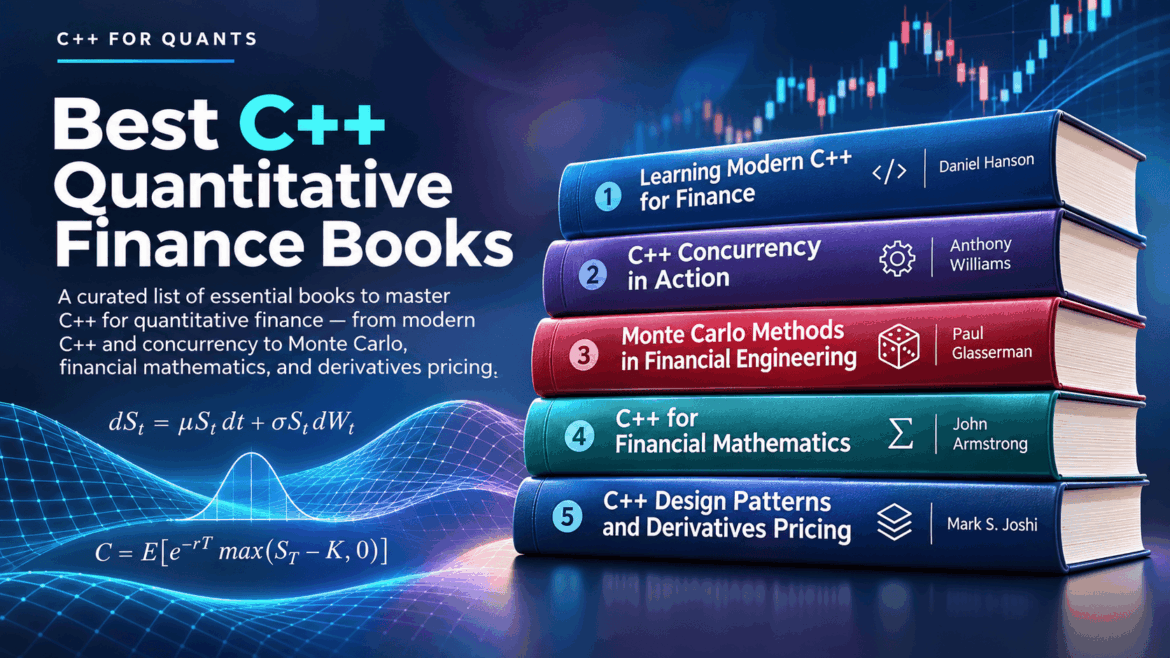
C++ remains one of the most important programming languages in quantitative finance. From derivatives pricing and Monte Carlo simulations to risk engines and high-performance trading systems, it plays a central role in building the infrastructure used by banks, hedge funds, and trading firms.
But becoming a strong C++ quant developer requires more than mastering the language itself. It means understanding numerical methods, financial mathematics, software architecture, concurrency, and performance optimization.
In this article, we explore some of the best books for C++ quantitative finance, covering both the mathematical foundations and the engineering practices needed to build reliable, efficient financial applications. You’ll find most of them on amazon.
1. “Learning Modern C++ for Finance” – Daniel Hanson
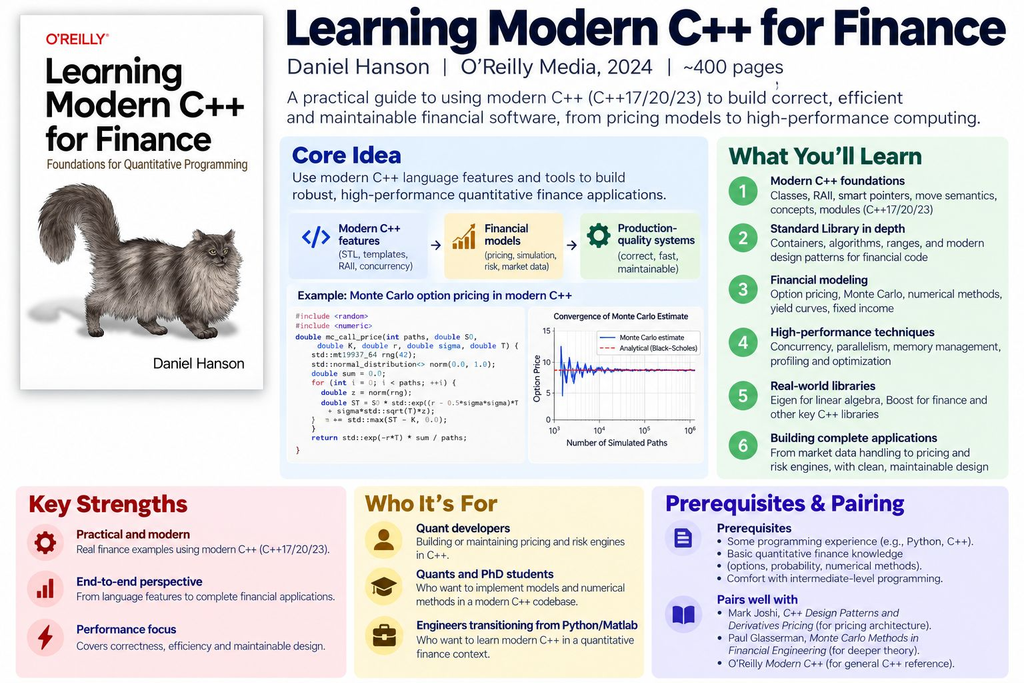
Learning Modern C++ for Finance by Daniel Hanson is a practical introduction to modern C++ programming through the lens of quantitative finance. It demonstrates how features introduced from C++11 onwards can make financial applications safer, more maintainable, and more efficient.
The book combines modern software engineering with real financial applications, including Black-Scholes option pricing, Monte Carlo simulation, fixed-income securities, and numerical computing.
What You’ll Learn:
- Modern C++: Smart pointers, move semantics, lambda expressions, templates, and object-oriented programming.
- STL and algorithms: Containers, iterators, ranges, and standard algorithms for efficient data processing.
- Financial modelling: Implementing option pricing, implied volatility calculations, and fixed-income applications.
- Monte Carlo and concurrency: Random number generation, simulation techniques, and parallel programming.
- Numerical computing: Linear algebra, mathematical libraries, and Boost.
- Modern language features: An introduction to C++ modules and concepts.
Why It Matters
Unlike traditional C++ textbooks that focus primarily on language syntax, Hanson connects programming concepts directly to financial problems. It provides a bridge between understanding modern C++ and applying it to quantitative pricing and analytical systems.
Who It’s For
Quant developers, financial engineers, and C++ programmers looking to strengthen their modern C++ skills while working through practical financial examples.
Verdict: An excellent starting point for developers who already have some programming experience and want to understand how modern C++ is applied in quantitative finance. It offers a strong foundation before moving into more specialized topics such as advanced numerical methods, derivatives pricing architecture, or high-performance concurrency.
2. “C++ Concurrency in Action” – Anthony Williams
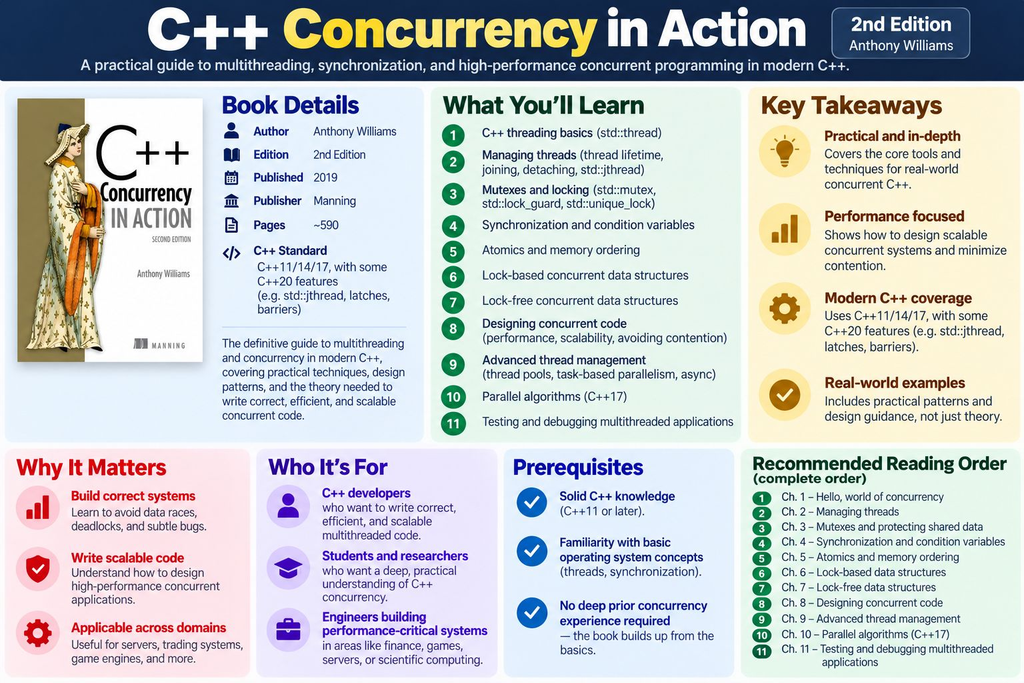
C++ Concurrency in Action by Anthony Williams is one of the most comprehensive references for mastering multithreaded programming in modern C++. It explains how to design, implement, and optimize concurrent applications while avoiding common pitfalls such as race conditions, deadlocks, and data corruption.
The book covers concurrency features introduced in C++11, C++14, and C++17, progressing from basic thread management to advanced synchronization, lock-free data structures, thread pools, and parallel algorithms.
What You’ll Learn:
- Thread management: Creating, managing, and coordinating threads using
std::threadand RAII techniques. - Synchronization: Mutexes, locks, condition variables, futures, and promises for safe communication between threads.
- Atomic operations: Understanding the C++ memory model,
std::atomic, memory ordering, and lock-free programming. - Concurrent data structures: Designing thread-safe queues, stacks, and lock-based or lock-free containers.
- Performance optimization: Understanding contention, false sharing, cache behavior, scalability, and Amdahl’s law.
- Advanced concurrency: Implementing thread pools, work-stealing mechanisms, and parallel algorithms, alongside testing and debugging multithreaded applications.
Why It Matters
Performance is critical in quantitative finance. Monte Carlo simulations, pricing engines, risk calculations, and market data processing frequently involve workloads that can benefit from parallel execution.
However, adding threads does not automatically improve performance. Poor synchronization, excessive contention, and inefficient memory access can make systems slower or introduce subtle correctness issues.
Williams provides the theoretical and practical foundations needed to build concurrent C++ systems that are both efficient and reliable.
Who It’s For
Quant developers, low-latency trading engineers, and C++ programmers working on computationally intensive financial applications. It is especially valuable for developers preparing for performance-oriented C++ interviews or building production pricing, simulation, and risk infrastructure.
Verdict: An essential reference for mastering concurrency in C++. Although it is not specifically a quantitative finance textbook, its techniques are directly applicable to high-performance financial systems. It pairs particularly well with books on Monte Carlo methods and numerical finance, where parallel execution can significantly reduce computation times.
Its main limitation is that the second edition predates standardized C++20 concurrency additions, such as std::jthread and std::stop_token. Nevertheless, its treatment of threads, synchronization, atomics, and performance remains highly relevant.
3. “Monte Carlo Methods in Financial Engineering” – Paul Glasserman
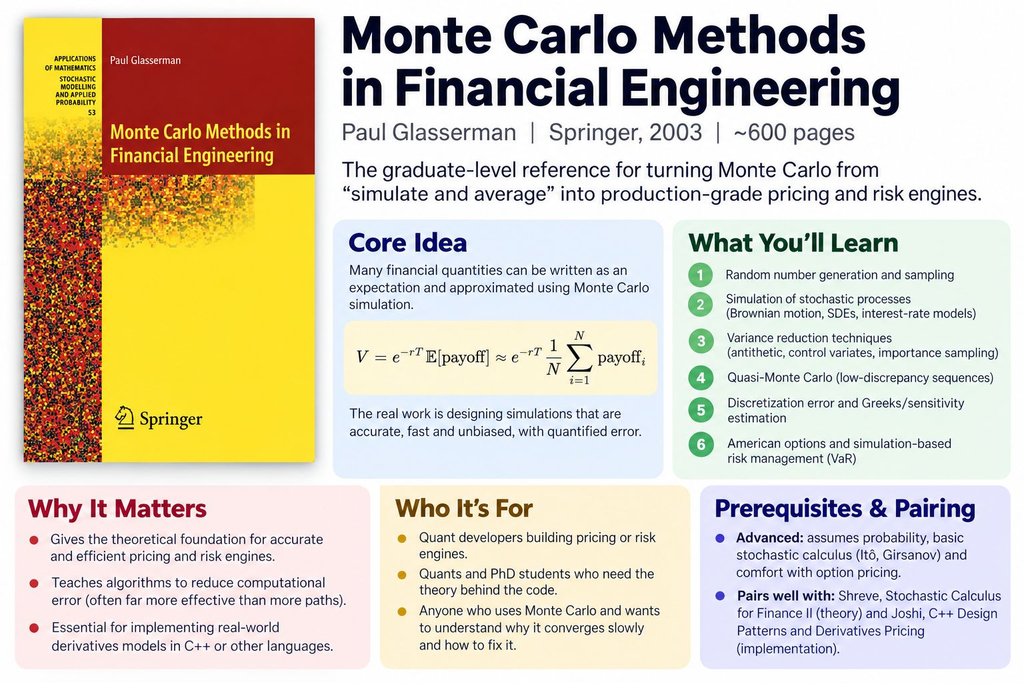
Monte Carlo Methods in Financial Engineering by Paul Glasserman is one of the most comprehensive references on simulation techniques used in quantitative finance. It provides a rigorous mathematical foundation for Monte Carlo methods, explaining how to design accurate, efficient simulations for derivatives pricing, risk management, and financial modelling.
The book moves beyond basic random sampling to explore advanced techniques for improving simulation accuracy, reducing computational costs, and handling complex financial instruments.
What You’ll Learn:
- Monte Carlo fundamentals: Random number generation, sampling techniques, convergence, and statistical error estimation.
- Stochastic processes: Simulating Brownian motion, stochastic differential equations, and financial models for asset prices and interest rates.
- Variance reduction: Antithetic variates, control variates, importance sampling, and stratification to improve simulation efficiency.
- Quasi-Monte Carlo: Low-discrepancy sequences and techniques for achieving more effective numerical integration.
- Sensitivity estimation: Calculating option Greeks using pathwise derivatives, likelihood ratio methods, and related techniques.
- Advanced applications: Pricing American-style options, simulating complex derivatives, and estimating financial risk measures such as Value at Risk.
Why It Matters
Monte Carlo simulation is a fundamental technique in quantitative finance, particularly when analytical solutions are unavailable or financial products involve complex, path-dependent payoffs.
However, accurate financial simulations require more than generating random numbers and averaging results. Numerical bias, sampling error, discretization techniques, and computational efficiency can significantly influence pricing and risk calculations.
Glasserman explains how to address these challenges systematically, providing the mathematical tools needed to build more accurate and computationally efficient pricing and risk engines.
Who It’s For
Quantitative researchers, derivatives pricing specialists, financial engineers, and quant developers building simulation-based pricing or risk systems. It is particularly valuable for readers with a solid background in probability, numerical methods, and stochastic calculus.
Verdict: A foundational reference for anyone working seriously with Monte Carlo methods in quantitative finance. Although it is not a C++ programming textbook, its algorithms and mathematical techniques are directly applicable to implementing high-performance simulation engines in C++.
It pairs particularly well with C++ Concurrency in Action, which provides the programming techniques needed to parallelize computationally intensive simulations, and C++ Design Patterns and Derivatives Pricing, which explores how to structure reusable financial software.
Its main limitation is its mathematical difficulty: readers looking for an introductory, code-oriented tutorial may find it demanding. For those developing advanced pricing and risk systems, however, it remains an exceptionally valuable reference.
4. C++ for Financial Mathematics
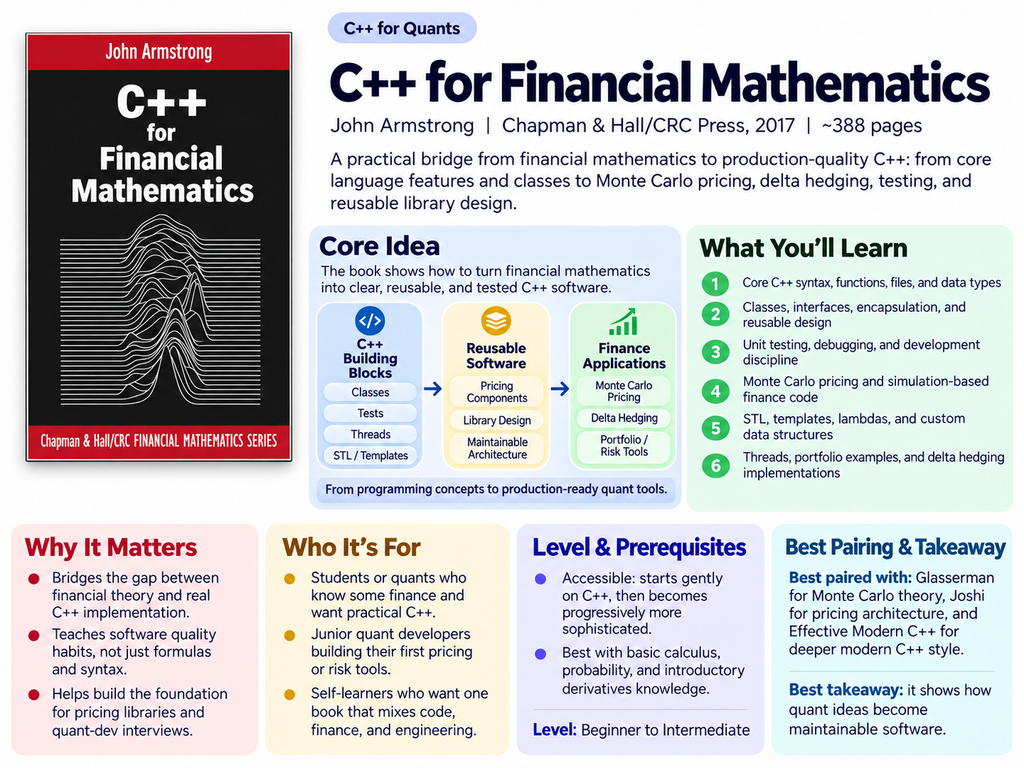
C++ for Financial Mathematics by John Armstrong is a practical introduction to C++ programming specifically designed for financial mathematics and quantitative finance. It takes readers from fundamental programming concepts to building reusable financial libraries, using real-world financial applications to illustrate each step.
The book combines essential C++ programming techniques with derivatives pricing, Monte Carlo simulations, portfolio modelling, and software engineering principles. Its step-by-step approach makes it particularly accessible to readers with a mathematical or financial background who want to develop their programming skills.
What You’ll Learn:
- C++ fundamentals: Variables, functions, control flow, classes, pointers, and object-oriented programming.
- Financial modelling: Implementing derivatives pricing models, Monte Carlo simulations, and risk-neutral valuation.
- Software architecture: Designing reusable financial libraries using interfaces, classes, and encapsulation.
- Portfolio management: Building portfolio classes and exploring delta hedging through practical implementations.
- Numerical computing: Working with arrays, matrices, templates, and the Standard Template Library (STL).
- Software engineering: Unit testing, debugging, development tools, lambda functions, and an introduction to multithreading.
Why It Matters
Quantitative finance requires more than understanding mathematical models. Turning pricing formulas and financial algorithms into reliable software is a separate challenge, particularly for researchers and financial mathematicians with limited programming experience.
Armstrong bridges this gap by introducing C++ concepts through concrete financial examples. Rather than teaching programming in isolation, the book progressively demonstrates how to build, test, and organize financial applications.
A particular strength is its emphasis on software engineering practices such as unit testing, modularity, and debugging — skills that are essential when moving from academic financial models to production-quality systems.
Who It’s For
Aspiring quant developers, financial mathematics students, quantitative researchers, and finance professionals learning C++. It is especially well suited to readers who understand basic financial concepts but have limited experience with object-oriented programming or software development.
Verdict: An excellent entry point into C++ for quantitative finance, particularly for readers transitioning from mathematics, finance, Python, or MATLAB into C++ development.
It complements Learning Modern C++ for Finance by offering a more introductory, step-by-step approach, while providing a practical foundation for more advanced books on numerical methods, concurrency, and derivatives pricing architecture.
Its main limitation is that it is not a comprehensive guide to the latest C++ standards or advanced performance optimization. Developers already experienced with modern C++ may find some introductory chapters too elementary. Nevertheless, its financial examples and focus on good software design make it a valuable reference for aspiring quantitative developers.
5. C++ Design Patterns and Derivatives Pricing — Mark S. Joshi
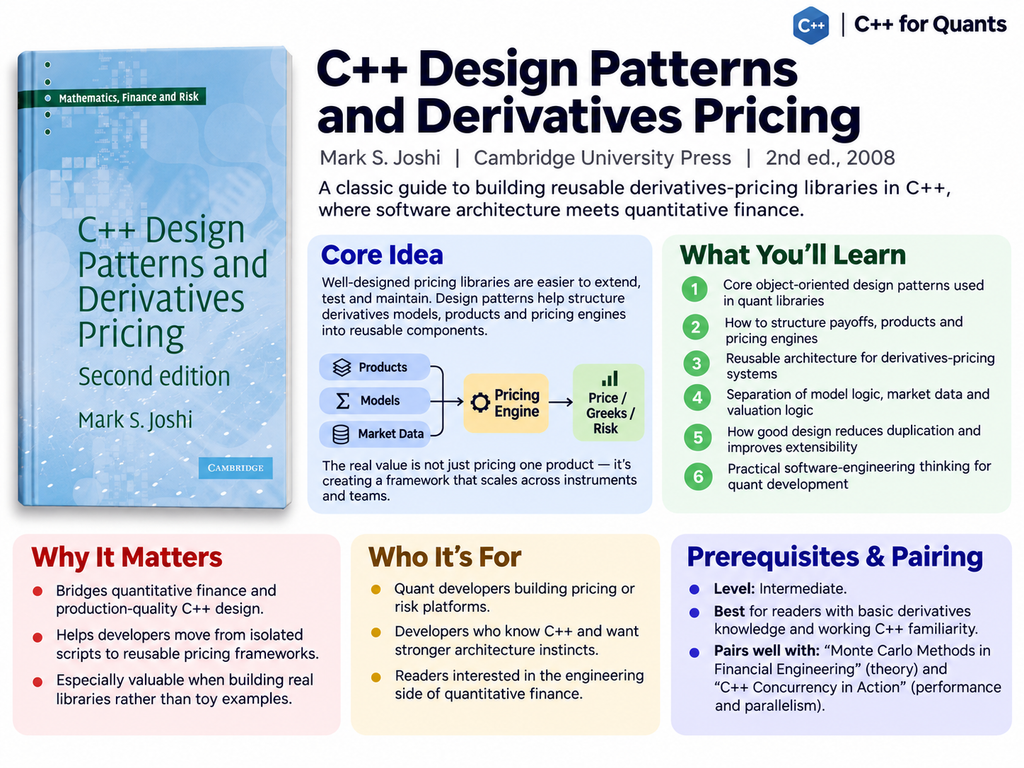
C++ Design Patterns and Derivatives Pricing by Mark S. Joshi is a classic reference for designing reusable, maintainable, and extensible financial software in C++. It demonstrates how object-oriented programming and software design patterns can be applied to real quantitative finance problems, particularly derivatives pricing and Monte Carlo simulation.
Rather than focusing exclusively on mathematical models or C++ syntax, the book explores how to structure financial applications into well-designed components. Starting with a simple Monte Carlo option pricer, Joshi progressively introduces abstractions, design patterns, and architectural improvements that transform basic implementations into more flexible pricing frameworks.
What You’ll Learn:
- Object-oriented design: Encapsulation, inheritance, polymorphism, virtual functions, and abstract interfaces for financial applications.
- Design patterns: Applying factory, strategy, decorator, adapter, bridge, and template method patterns to quantitative software.
- Derivatives pricing architecture: Designing reusable payoff classes, pricing engines, and financial model components.
- Monte Carlo frameworks: Building extensible simulation engines with interchangeable random number generators, path generators, and statistical estimators.
- Numerical methods: Implementing tree-based pricing models, root-finding algorithms, and implied volatility calculations using C++ templates.
- Software engineering: Improving exception safety, reducing coupling between components, and integrating C++ financial models with Excel.
Why It Matters
In quantitative finance, implementing a pricing formula is often only a small part of the engineering challenge. Production systems must support multiple financial instruments, pricing models, market data sources, and evolving business requirements.
Without a well-designed architecture, even mathematically correct pricing implementations can become difficult to extend, test, and maintain.
Joshi demonstrates how established software design patterns address these challenges. By separating financial products, models, and numerical methods into reusable components, developers can build pricing libraries that are easier to maintain and extend as requirements evolve.
A particular strength of the book is its progressive approach: readers see how a simple implementation can be refactored into a more sophisticated software architecture, with each design decision motivated by a concrete financial problem.
Who It’s For
Quant developers, financial engineers, and C++ programmers building derivatives pricing or risk management systems. It is especially valuable for developers who already understand basic C++ and financial mathematics but want to improve their software architecture and object-oriented design skills.
Verdict: A highly valuable reference for understanding how to engineer reusable derivatives pricing libraries in C++. Its focus on design patterns and software architecture makes it particularly relevant to developers working on large financial systems where maintainability, extensibility, and code reuse are essential.
It complements Monte Carlo Methods in Financial Engineering, which provides the mathematical foundations for simulation-based pricing, and C++ Concurrency in Action, which explores techniques for parallel and high-performance execution.
Its main limitation is its age. Published before C++11, the second edition relies on older C++ idioms and does not cover modern language features such as move semantics, smart pointers from the standard library, concepts, or contemporary generic programming techniques.
Nevertheless, the architectural principles remain highly relevant. For quant developers looking to progress from implementing individual pricing algorithms to designing complete financial software frameworks, it is an excellent resource.