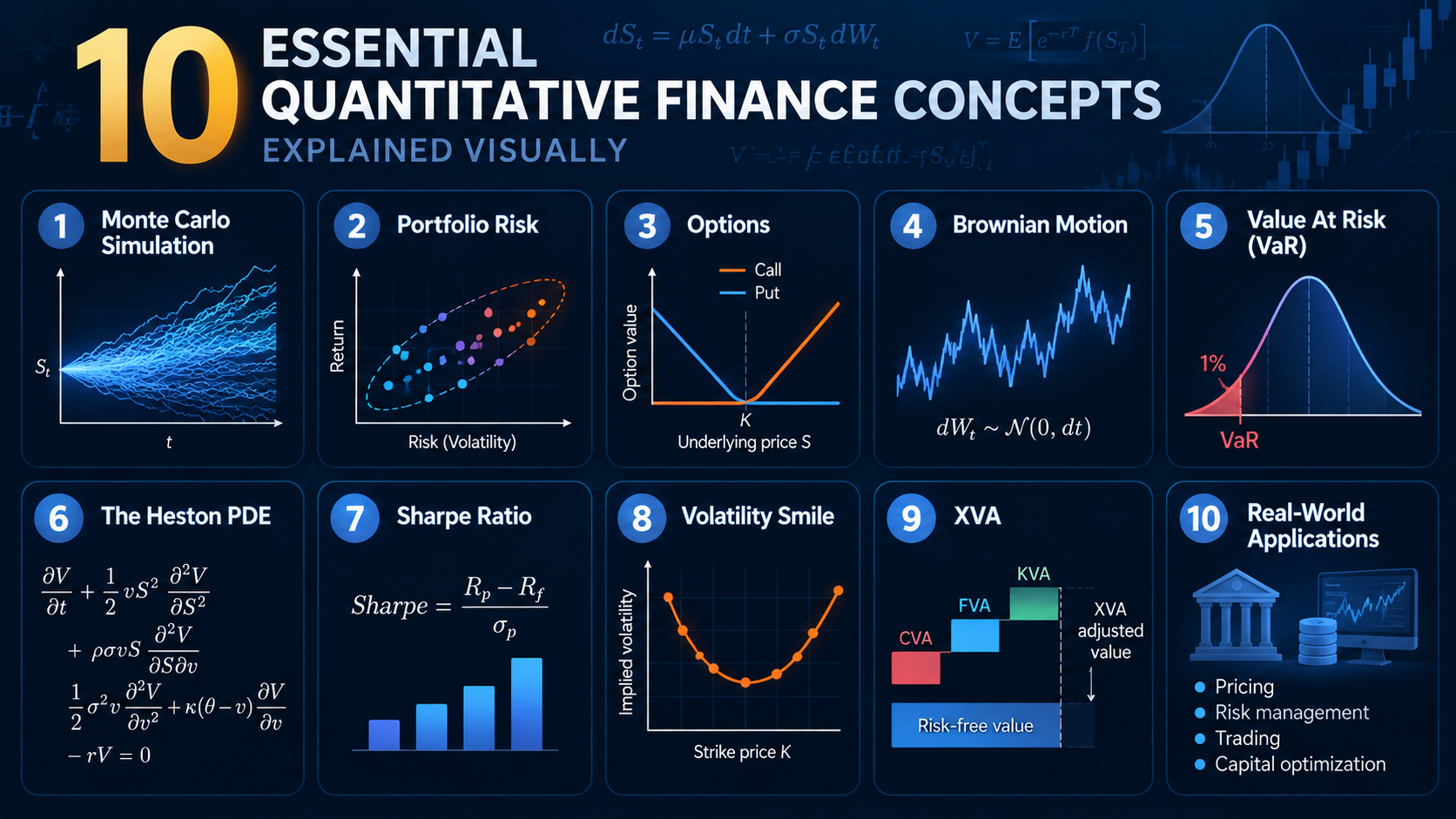
Quantitative finance combines mathematics, statistics, programming, and financial theory to model markets, price financial instruments, and manage risk. From stochastic processes to complex derivatives, it provides the mathematical foundations behind modern trading and risk management systems. What are top 10 quant finance concepts?
Whether you’re a quantitative developer, researcher, trader, or software engineer entering the industry, this guide provides a visual overview of the concepts that underpin quantitative finance.
1.Monte Carlo Simulations
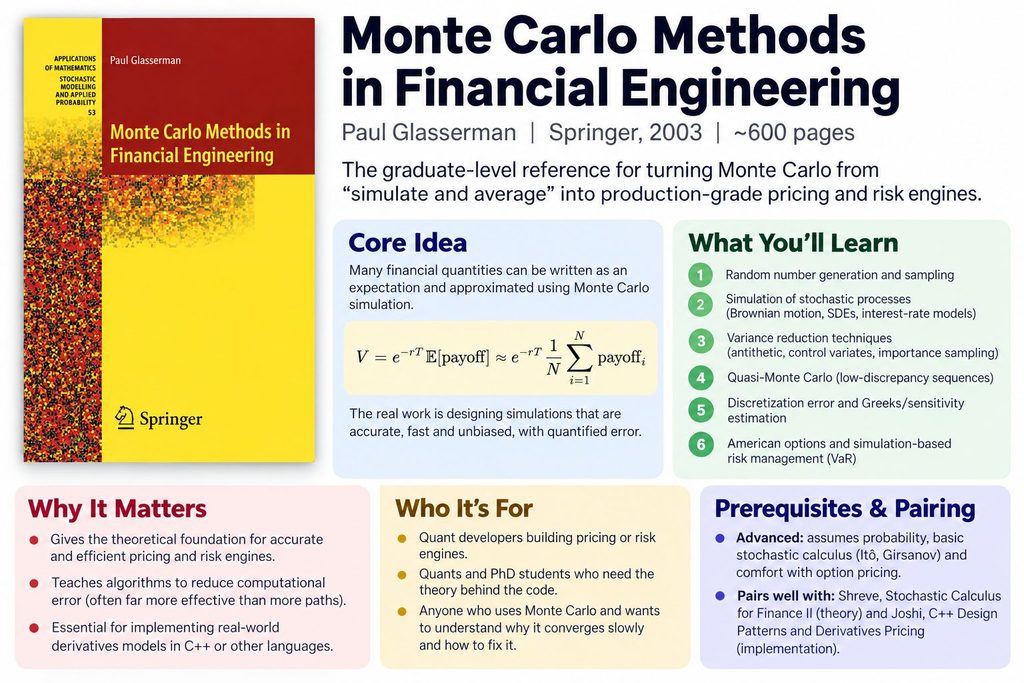
Monte Carlo simulations are a fundamental technique in quantitative finance, used to model uncertainty and estimate the value of complex financial instruments. By generating thousands or millions of possible future market scenarios, they help quantify risk and price derivatives. The method is particularly useful when analytical solutions are unavailable, such as for path-dependent options and complex portfolios.
2.Derivatives
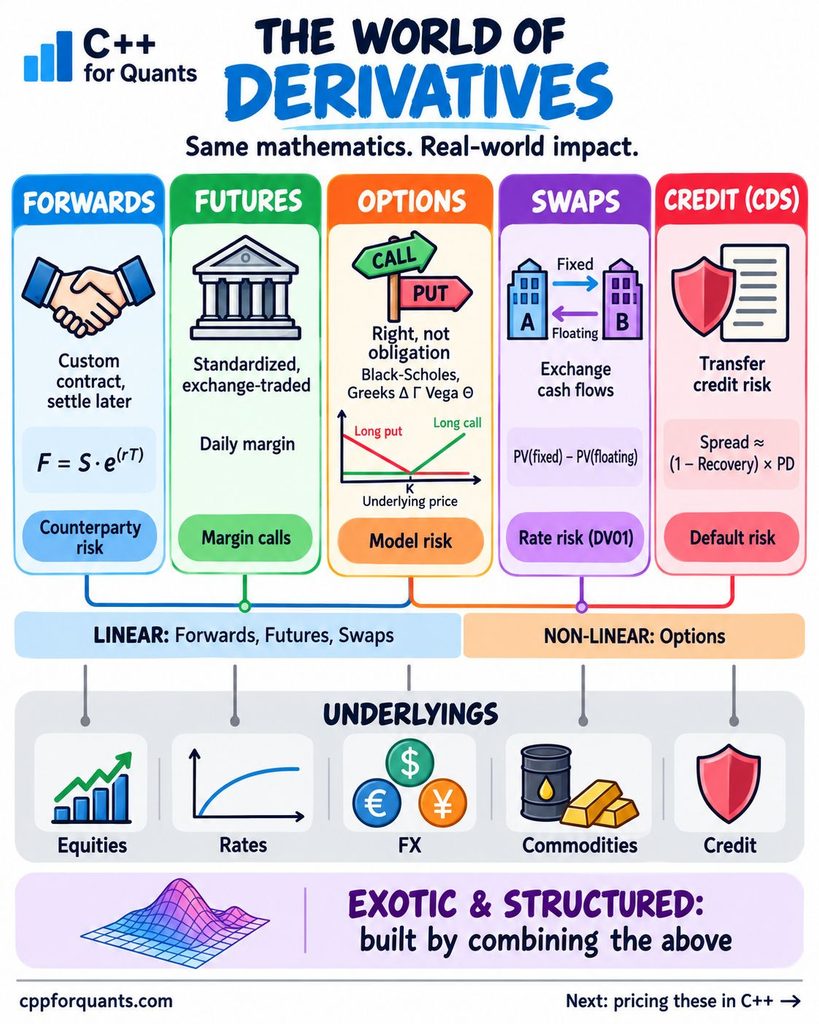
Derivatives are financial instruments whose value depends on an underlying asset, such as a stock, bond, interest rate, or commodity. Common examples include options, futures, forwards, and swaps. Widely used for hedging, speculation, and risk management, derivatives are central to quantitative finance, where mathematical models help determine their fair value and measure their sensitivity to market movements.
3.Portfolio Risk
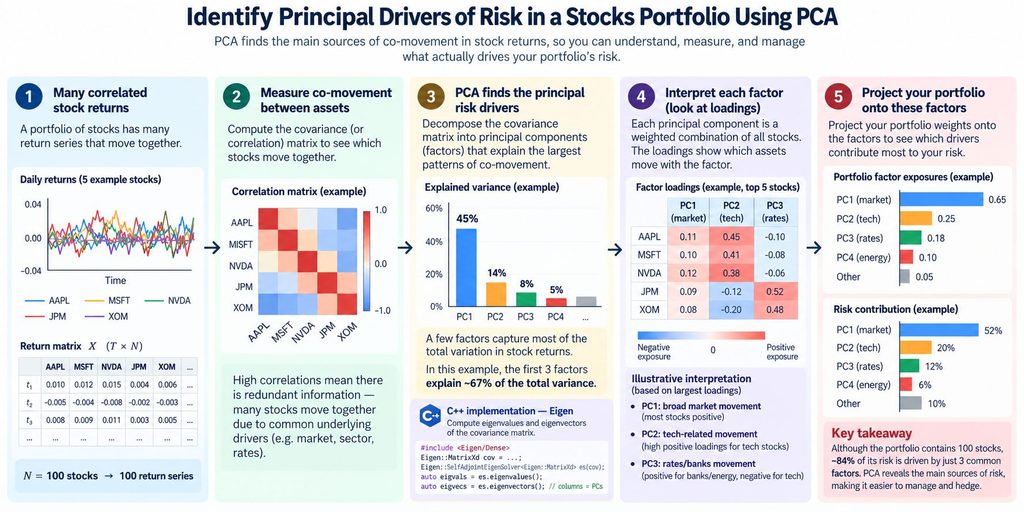
Portfolio risk measures the potential losses and uncertainty associated with a collection of financial assets. It depends not only on the risk of individual positions but also on their correlations and diversification effects. Quantitative finance uses metrics such as Value at Risk (VaR), Expected Shortfall (ES), and volatility to assess portfolio exposure, estimate potential losses, and support risk management decisions.
4.Options
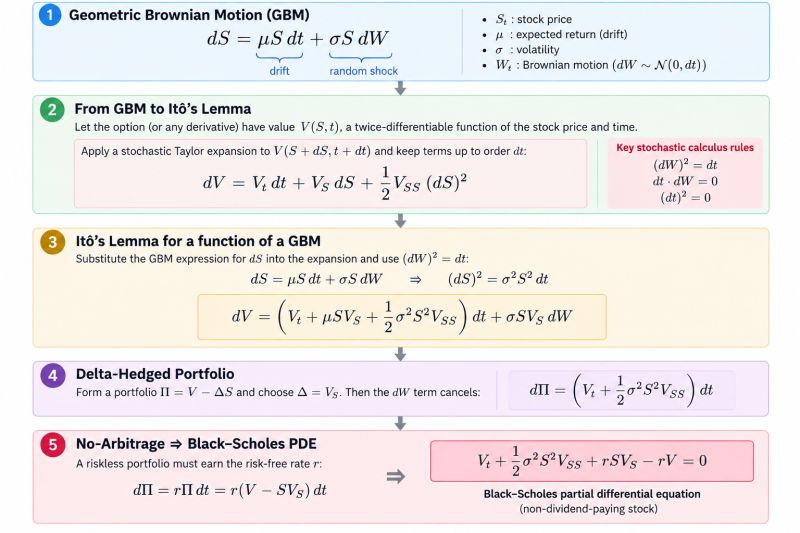
Options are financial derivatives that give the holder the right, but not the obligation, to buy or sell an underlying asset at a predetermined price. Call options provide the right to buy, while put options provide the right to sell. Their value depends on factors such as the underlying asset price, volatility, time to expiration, and interest rates. Quantitative models such as Black–Scholes are widely used to price options and measure their risk sensitivities, known as the Greeks.

5.Brownian Motion
Brownian motion is a stochastic process used in quantitative finance to model random fluctuations in financial markets. It forms the mathematical foundation of many asset pricing models, including Black–Scholes, by representing unpredictable changes over time. Its key properties include independent, normally distributed increments and continuous paths, making it essential for modelling asset prices, interest rates, and financial derivatives.
6.Value At Risk
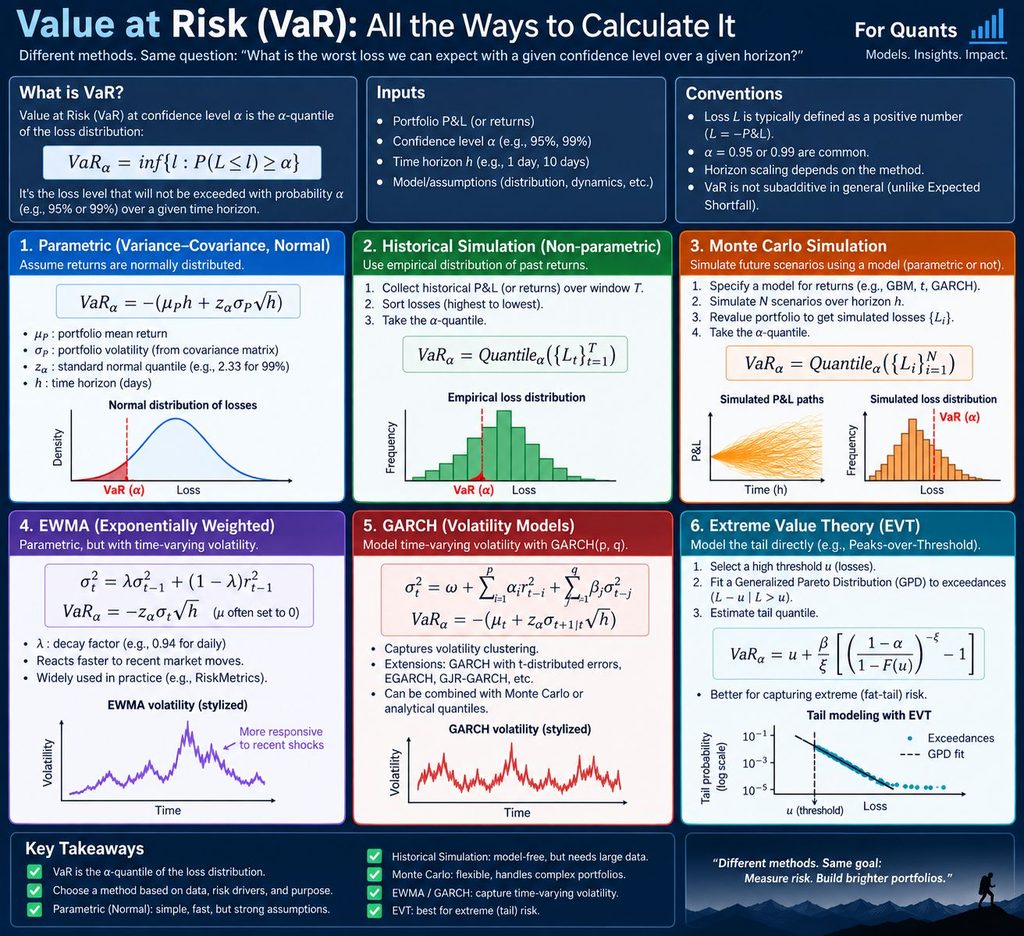
Value at Risk (VaR) is a widely used risk metric that estimates a loss threshold for a portfolio over a specified time horizon and confidence level. For example, a one-day 99% VaR of $1 million means there is a 1% probability of losing more than $1 million in a single day, under the model’s assumptions. VaR can be calculated using historical simulation, parametric methods, or Monte Carlo simulations, making it a key tool in market risk management.
7. The Heston PDE
The Heston partial differential equation (PDE) is used in quantitative finance to price derivatives under stochastic volatility. Unlike the Black–Scholes model, which assumes constant volatility, the Heston model allows variance to evolve randomly over time and to be correlated with the underlying asset price. Its PDE describes how an option’s value changes with the asset price, variance, and time, providing a framework for modelling volatility smiles and pricing complex derivatives.

8.Sharpe Ratio
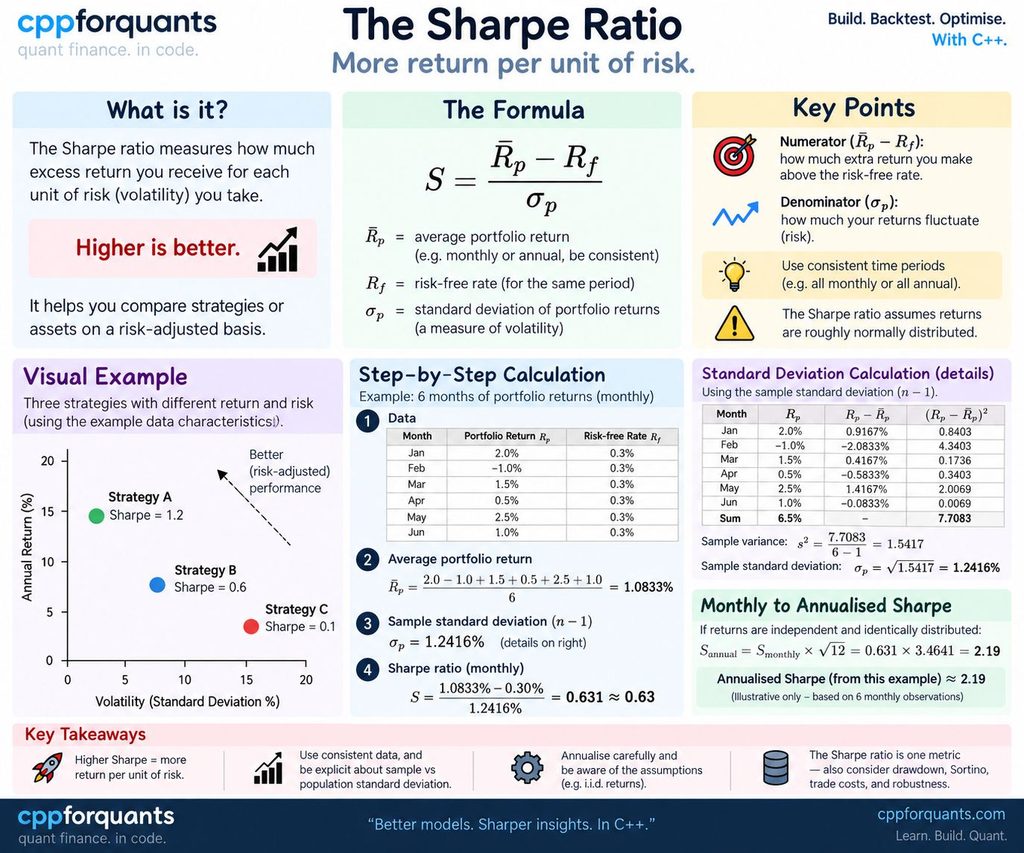
The Sharpe Ratio measures the risk-adjusted performance of an investment or portfolio by comparing its excess return over the risk-free rate to its volatility. A higher Sharpe Ratio indicates greater return per unit of risk, making it a widely used metric for comparing investment strategies. It is particularly useful in portfolio optimization, asset management, and quantitative trading, although it does not distinguish between upside and downside volatility.
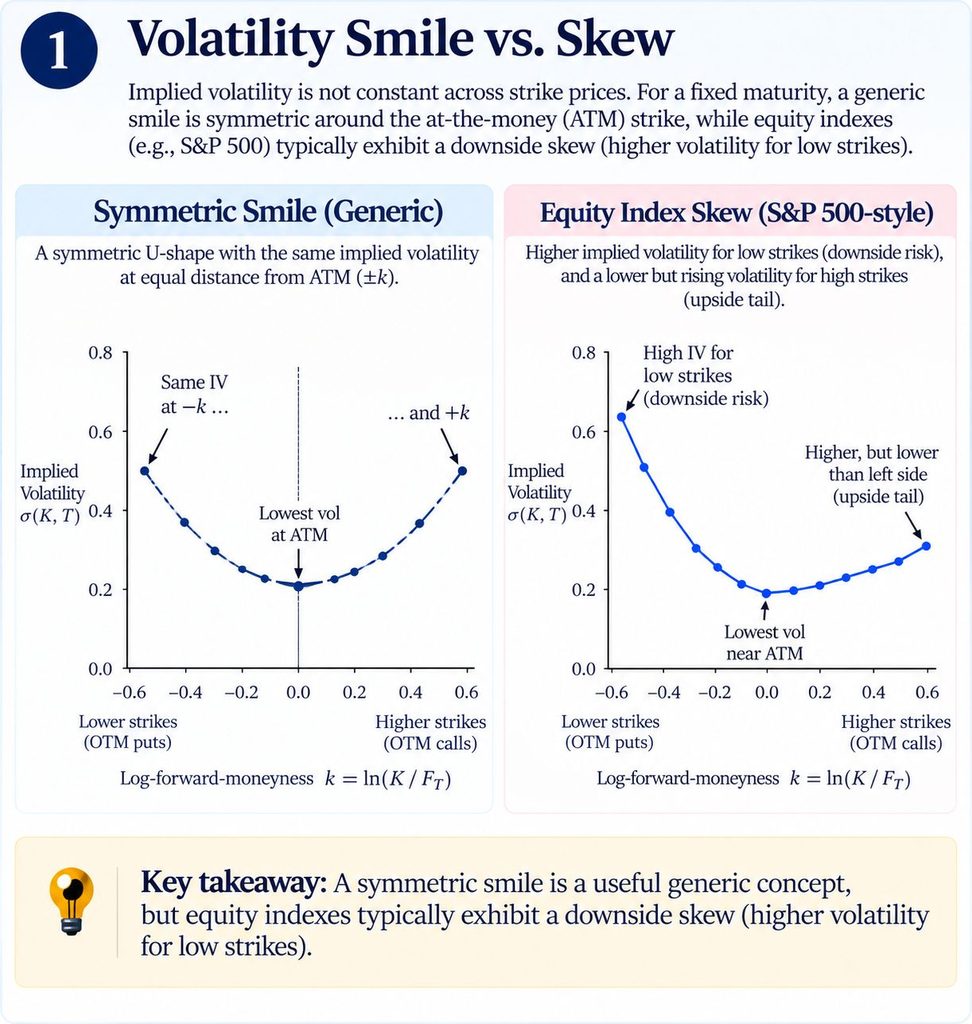
9. Volatility Smile
The volatility smile describes how the implied volatility of options varies across different strike prices for the same underlying asset and expiration date. Unlike the Black–Scholes model’s constant-volatility assumption, observed option prices often imply higher volatility for deep in-the-money or out-of-the-money options. This pattern reflects market expectations of extreme price movements and is essential for volatility modelling, derivatives pricing, and risk management.
10.XVA
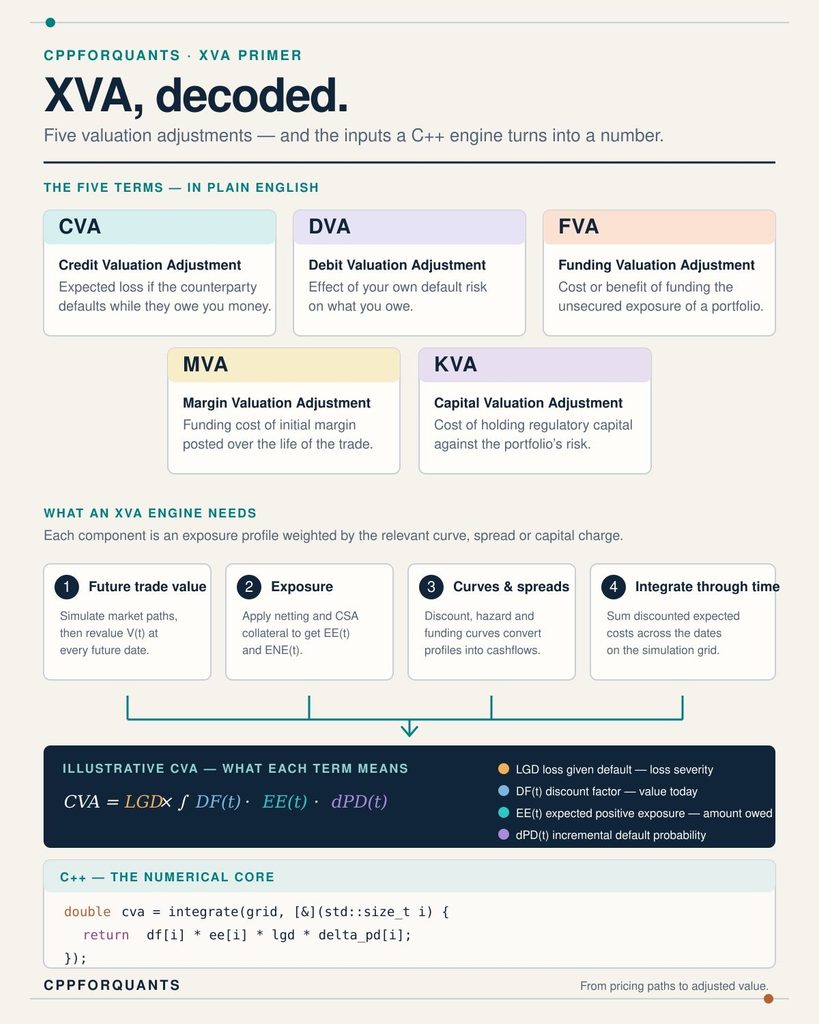
XVA (Valuation Adjustments) refers to a family of adjustments applied to derivative valuations to account for counterparty credit risk, funding costs, collateral, and capital requirements. Common examples include Credit Valuation Adjustment (CVA), Funding Valuation Adjustment (FVA), and Capital Valuation Adjustment (KVA). These adjustments often rely on Monte Carlo simulations to estimate future exposures and are essential for pricing, risk management, and capital optimization in modern derivatives trading.