
C++ for Quants
  • Home
  • News
  • Contact
  • About
Author

cppforquants

cppforquant.com
cppforquants

compfinance
Libraries

CompFinance: A C++ Library To Learn Quantitative Trading

by cppforquants April 2, 2026

If you’ve ever tried to implement Automatic Adjoint Differentiation from scratch for a real derivatives pricing engine, you already know the gap between understanding the theory and shipping something that actually performs. Antoine Savine’s Modern Computational Finance is one of the few books that closes that gap honestly, and CompFinance is the companion code that makes it actionable. This isn’t a toy implementation tossed together to illustrate textbook concepts — it’s a reference codebase written by someone who built these systems professionally at Danske Bank, and it shows in every design decision.

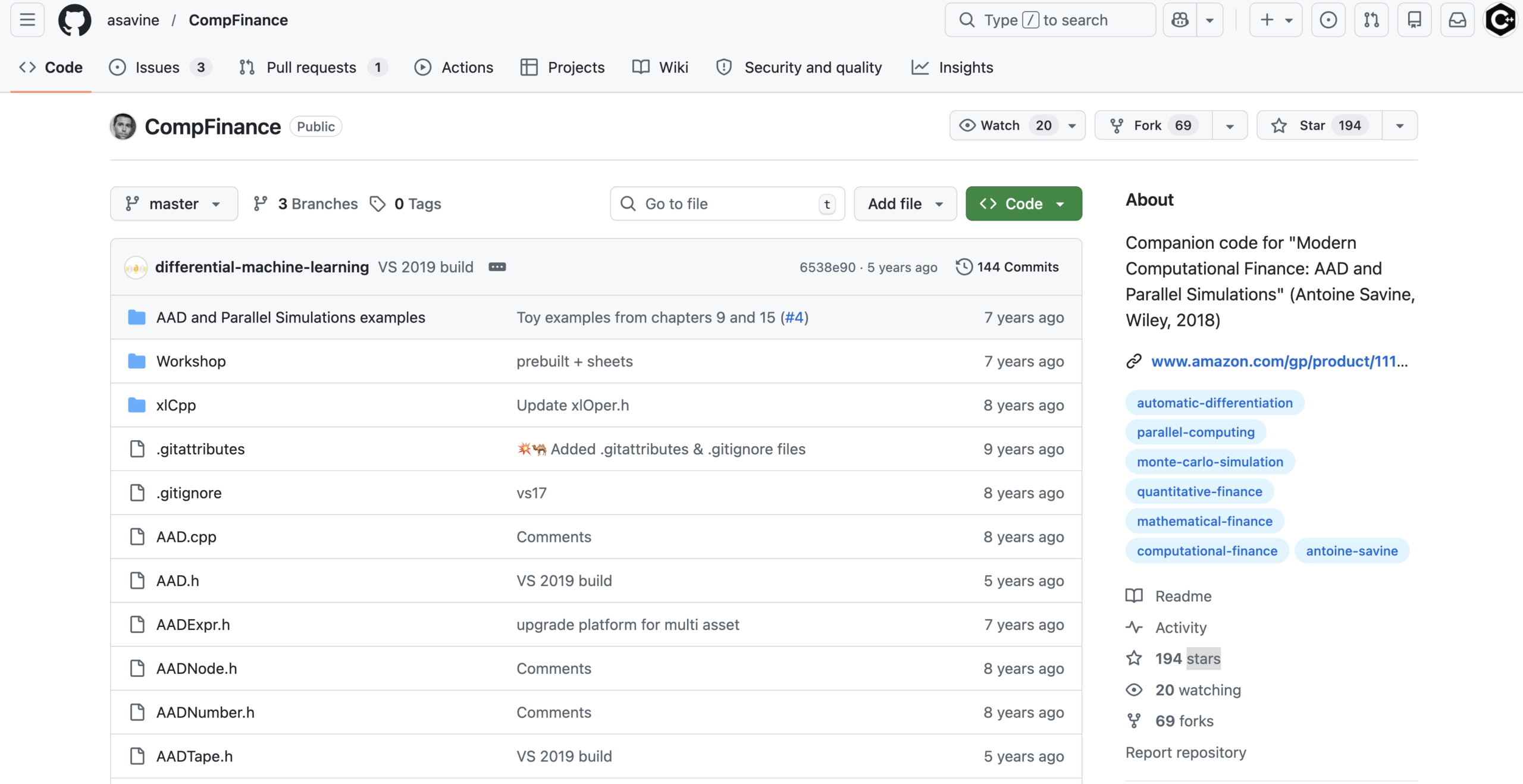
GitHub: asavine/CompFinance — 194★, 69 forks

What makes this repository worth your time is its direct relevance to the problems that actually consume quant engineering teams: computing Greeks and XVA sensitivities at scale without crippling your Monte Carlo throughput. The AAD implementation here demonstrates the adjoint pattern applied to a realistic financial model, not a contrived academic example. Parallel simulation infrastructure is treated as a first-class concern, not an afterthought bolted on after the math was already written.

For intermediate-to-advanced C++ developers working in derivatives pricing or risk, this repo is the kind of reference you bookmark and return to repeatedly — not for copying, but for understanding how the pieces fit together when correctness, performance, and maintainability all have to coexist.

What Is CompFinance?

The CompFinance library is the production C++ implementation accompanying Antoine Savine‘s Modern Computational Finance: AAD and Parallel Simulations (Wiley, 2018).

It solves a core problem in quantitative finance: computing derivatives (sensitivities, or “Greeks”) of complex financial models efficiently and correctly, while also running Monte Carlo simulations at scale across multiple threads.

The library is split into two cooperating subsystems. The files prefixed AAD* form a self-contained, general-purpose Adjoint Algorithmic Differentiation (AAD) engine. Rather than relying on finite differences or hand-coded analytic gradients, AAD propagates derivatives backward through a recorded computation tape, yielding exact gradients at a cost roughly proportional to a single forward pass. The implementation incorporates advanced techniques from chapters 10, 14, and 15 of the book — including memory-efficient tape management via blocklist.h and analytic treatment of Gaussian functions via gaussians.h — making it notably faster than naive AAD approaches.

The files prefixed mc* constitute a generic parallel simulation framework for financial payoffs. It abstracts models, products, and random-number generation into composable components, with parallelism handled by threadPool.h, a custom thread pool developed in part I of the book.

The primary entry point is main.h, which exposes high-level functions combining both subsystems. A typical usage pattern wraps a computation in an AAD-aware type so the tape records operations automatically:

Number x = 1.5;          // AAD active variable
Number y = exp(-x * x);  // operations recorded on tape
y.propagateAdjoints();   // reverse pass
double dydx = x.adjoint();

The project targets C++17 and is configured for maximum optimization via an included Visual Studio 2017 project (xlComp.vcxproj).

How It Fits Into a Finance C++ Stack

In a derivatives desk risk engine, a quant developer needs to price thousands of European and barrier options across multiple underlyings every second as market data ticks in. The asavine/CompFinance library — based on Antoine Savine’s Modern Computational Finance — provides production-ready automatic differentiation (AAD) alongside Monte Carlo and finite difference solvers, making it a natural fit for real-time Greeks computation without finite-difference bumping overhead.

Consider a scenario where a risk engine reprices a vanilla European call and computes delta and vega analytically via AAD on each market data update:

#include "aad.h"
#include "gaussians.h"

double priceAndGreeks(double S, double K, double r, double vol, double T,
                      double& delta, double& vega) {
    // Wrap inputs as AAD numbers
    Number nS(S), nK(K), nR(r), nVol(vol), nT(T);
    Number::tape->rewind();

    double d1val = (log(S / K) + (r + 0.5 * vol * vol) * T) / (vol * sqrt(T));
    Number d1(d1val);
    Number price = nS * Number(normalCdf(d1val))
                 - nK * Number(exp(-r * T)) * Number(normalCdf(d1val - vol * sqrt(T)));

    price.propagateToInputs();

    delta = nS.adjoint();
    vega  = nVol.adjoint();
    return price.value();
}

Rather than bumping each input independently — which costs O(n) pricings for n risk factors — AAD delivers all sensitivities in roughly the cost of two forward passes. Rolling your own AAD is notoriously error-prone, requiring careful tape management, memory pooling, and expression-template design. Alternatives like QuantLib lack first-class AAD integration, and commercial AD tools (NAG, dco/c++) add licensing cost and vendor lock-in. CompFinance ships with a battle-tested, open-source tape implementation tuned specifically for financial payoffs, letting a quant developer focus on model logic rather than infrastructure.

Project Health

The CompFinance library shows moderate but concerning signs of decline. With 194 stars and 69 forks, it has a reasonable user base, yet the last commit dates to September 2021—nearly three years ago—suggesting active maintenance has stalled. The four open issues remain unresolved, and recent commits reveal a pattern of minor fixes and documentation updates rather than feature development or security patches. The unknown license status is a red flag for production adoption, as it creates legal ambiguity. Commit messages indicate work on multi-asset support and numerical methods (Sobol points), suggesting the library targets quantitative finance, but the lack of recent activity means no assurance of compatibility with modern dependencies or security vulnerabilities. The project appears to be in maintenance limbo rather than active development.

Verdict: Not recommended for production without thorough code review, security audit, and confirmation that you can maintain it independently if the original authors don’t resume activity.

The Verdict

Use it if: you need to price complex derivatives and structured products with minimal setup—asavine’s computational finance framework handles multi-asset, multi-curve scenarios elegantly.

Skip it if: you’re building a real-time trading system where microsecond latency matters more than mathematical elegance.

April 2, 2026 0 comments
LibrariesPerformance

Detecting Arithmetic Overflow in C++: Finance-Safe Arithmetic

by cppforquants April 2, 2026

Somewhere in a production pricing engine, a 32-bit integer silently wraps around during a notional accumulation, a Greeks ladder miscounts its buckets, or a risk aggregation quietly produces a number that is just slightly wrong — and nobody notices until the end-of-day reconciliation, or worse, until a trader calls. Arithmetic overflow is one of the oldest bugs in systems programming, yet in C++ it carries a particularly sharp edge: signed overflow is undefined behaviour, meaning the compiler is not only permitted to produce a wrong answer, it is permitted to optimise away the very branch you wrote to catch it. In latency-sensitive financial code, where you’re burning through millions of option valuations or margin calculations per second, this is not a theoretical concern.


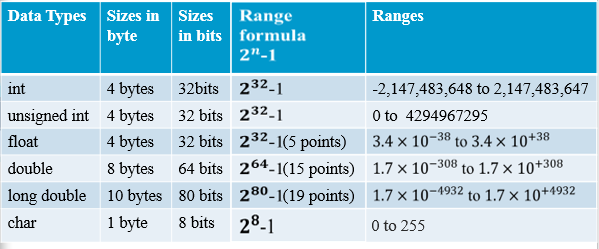
Ranges for data types in C++

The good news is that modern C++ — and GCC/Clang long before the standard caught up — gives you a near-zero-cost escape hatch: __builtin_add_overflow, __builtin_mul_overflow, and their family members. These compiler intrinsics lower directly to native overflow-checking instructions (think jo on x86 or the carry-flag variants), producing branch-predictable, exception-free code that slots cleanly into hot loops without touching the exception machinery or sacrificing throughput.

What Is Arithmetic overflow detection with __builtin_add_overflow / std::add_overflow (and the upcoming contracts alternative)?

Signed integer overflow in C++ is undefined behavior — the compiler is legally allowed to assume it never happens, which means optimizers can and do eliminate overflow checks written naively with if (a + b < a). This isn’t a theoretical concern; GCC and Clang routinely delete such guards under -O2. The problem demands a solution that is both correct and efficient.

GCC and Clang expose __builtin_add_overflow(a, b, &result), along with __builtin_sub_overflow and __builtin_mul_overflow. These builtins perform the arithmetic in the mathematical integers, store the wrapped result in *result, and return true if the true value doesn’t fit in the result type. Crucially, the type of result drives the overflow semantics — mixing signed and unsigned types works predictably because the check is against the destination type, not the operands. MSVC offers UIntAdd, IntAdd, etc. from <intsafe.h> for similar unsigned coverage, though without the same generality.

int a = INT_MAX, b = 1, result;
if (__builtin_add_overflow(a, b, &result)) {
    // overflow detected; result holds the wrapped value
}

Under the hood, modern compilers lower these to a single add + jo/jno (overflow flag check) on x86, or adds + branch on ARM — one instruction overhead, no undefined behavior.

C++26 is expected to introduce std::add_overflow and friends in <numeric>, standardizing the API surface across implementations. Separately, the Contracts proposal ([[pre]], [[post]]) enables expressing overflow preconditions declaratively, though contracts terminate rather than branch, making them unsuitable for recoverable overflow handling.

Common pitfalls: assuming the builtin is only for int — it works on any integral type including size_t. Forgetting that the result pointer type governs overflow semantics leads to subtle bugs when mixing widths. Finally, don’t use these builtins on floating-point; they’re strictly integral.

Practical Use Case in Finance

A high-frequency trading order aggregation engine must sum large 64-bit notional values across thousands of fills per second. Silent integer overflow here means a corrupted position — a catastrophic risk event.

Setup: Each fill carries a notional (quantity × price in cents). We accumulate these into a running total_notional. With values potentially in the billions, overflow is a real threat that must be caught immediately, not discovered during end-of-day reconciliation.

#include <cstdint>
#include <stdexcept>
#include <iostream>
#include <vector>

// Represents a single trade fill
struct Fill {
    int64_t notional_cents; // qty * price in cents (can be large)
};

// Accumulates notional with overflow protection.
// Uses GCC/Clang __builtin_add_overflow; on MSVC use safeint or manual check.
int64_t aggregate_notional(const std::vector<Fill>& fills) {
    int64_t total = 0;

    for (const auto& fill : fills) {
        int64_t next = 0;

        // __builtin_add_overflow returns true if overflow would occur,
        // storing the wrapped result in `next` (which we discard on error).
        if (__builtin_add_overflow(total, fill.notional_cents, &next)) {
            throw std::overflow_error(
                "Notional accumulation overflowed int64 — "
                "halt aggregation, alert risk desk immediately."
            );
        }

        total = next;
    }
    return total;
}

int main() {
    // Simulate fills approaching int64 limits
    int64_t near_max = INT64_MAX - 1000;
    std::vector<Fill> fills = {
        {near_max},
        {500},   // fine
        {600},   // this tips over the edge
    };

    try {
        int64_t result = aggregate_notional(fills);
        std::cout << "Total notional: " << result << " cents\n";
    } catch (const std::overflow_error& e) {
        std::cerr << "[RISK ALERT] " << e.what() << '\n';
        // In production: publish alert, reject batch, trigger circuit breaker
    }
}

What this demonstrates: __builtin_add_overflow performs the addition and overflow detection in a single CPU instruction (ADD + JO on x86), with zero overhead on the happy path — critical for a hot loop. Compared to pre-checking with INT64_MAX - a < b, it is both safer and faster. The upcoming C++26 Contracts feature ([[pre: ...]]) will allow expressing these invariants declaratively at function boundaries, but __builtin_add_overflow remains the practical tool today for inline arithmetic guards in latency-sensitive paths.

Learn More: A Video Worth Watching

Understanding integer overflow vulnerabilities is crucial for developers working in quantitative finance, where precision and correctness directly impact trading systems and risk calculations. This video from Marcus Hutchins provides an accessible introduction to how binary integers work and the mechanics behind overflow conditions—foundational knowledge that contextualizes why C++ provides built-in overflow detection tools like __builtin_add_overflow and the standardized std::add_overflow (coming in C++26).

For quant developers, grasping these fundamentals clarifies why relying on manual bounds checking is error-prone compared to language-level solutions. The video breaks down overflow vulnerabilities in clear terms, helping you appreciate why modern C++ contracts and overflow detection mechanisms matter for building robust financial algorithms. If you want to strengthen your understanding of the security and correctness issues that these C++ features address, this is an excellent primer.

Conclusion

Detecting arithmetic overflow is no longer optional in production systems. With __builtin_add_overflow and its standard library counterpart std::add_overflow, C++ developers have efficient, portable tools to catch silent integer wraparound before it corrupts data or enables exploits.

The key takeaway is simple: overflow checks need not be expensive. Modern compilers translate these intrinsics into single CPU instructions on most platforms, making defensive arithmetic genuinely zero-cost. Whether you’re managing financial calculations, sizing buffers, or computing timestamps, a three-line safety check pays dividends.

C++26’s contracts proposal will eventually offer syntactic elegance, but don’t wait—start using overflow detection functions today. Experiment in your codebase, measure the performance impact (spoiler: it’s negligible), and establish overflow-safe patterns as standard practice.

In high-performance and financial systems, silent integer overflow is a liability masquerading as efficiency. Reclaim both safety and speed.

Want to Go Deeper?

  • Explore more C++ feature articles: C++ for Quants — Features.

April 2, 2026 0 comments
News

Securitization Insights: Unlocking Finance’s Hidden Structures

by cppforquants April 2, 2026

“The market is a pendulum that forever swings between unsustainable optimism and unjustified pessimism.” – Benjamin Graham, renowned investor and author.

As global markets continue to navigate the ebbs and flows of economic uncertainty, prudent portfolio management remains key to weathering the storm. Today’s news highlights the resilience of the real estate investment trust (REIT) sector, as SmartStop Self Storage REIT marks its listing anniversary by ringing the opening bell at the New York Stock Exchange (NYSE). This symbolic gesture underscores the importance of understanding the role of third-party intermediaries in the intricate world of finance, as showcased in our upcoming video explainer. Additionally, the application of logistic regression modeling can unlock valuable insights and build trust in data-driven decision-making, while our financial engineering video dives into the intricacies of cash flow modeling for securitized loan products. As investors navigate the ever-evolving financial landscape, these tools and insights can prove invaluable in navigating the pendulum of market sentiment.

🎥 Today on NYSE Live | SmartStop Self Storage REIT Marks Listing Anniversary by Ringing Opening Bell (New York Stock Exchange)

In the latest installment of “NYSE Live,” viewers were treated to a captivating display of corporate milestone celebrations. The focus was on SmartStop Self Storage REIT, a real estate investment trust (REIT) that specializes in the self-storage industry. As the company marked the anniversary of its listing on the New York Stock Exchange, its executives gathered to ceremoniously ring the opening bell, signifying the start of the trading day. This event not only underscores the continued growth and success of SmartStop, but also highlights the resilience and adaptability of the self-storage sector. In a world where consumer behavior and economic conditions are constantly evolving, the self-storage industry has proven to be a reliable investment opportunity, offering steady returns and the potential for long-term appreciation. The participation of SmartStop in this NYSE Live segment serves as a testament to the industry’s prominence and the company’s commitment to engaging with its stakeholders.


🎥 Understanding Third-Party Intermediaries in Finance Explained #shorts (Dimitri Bianco)

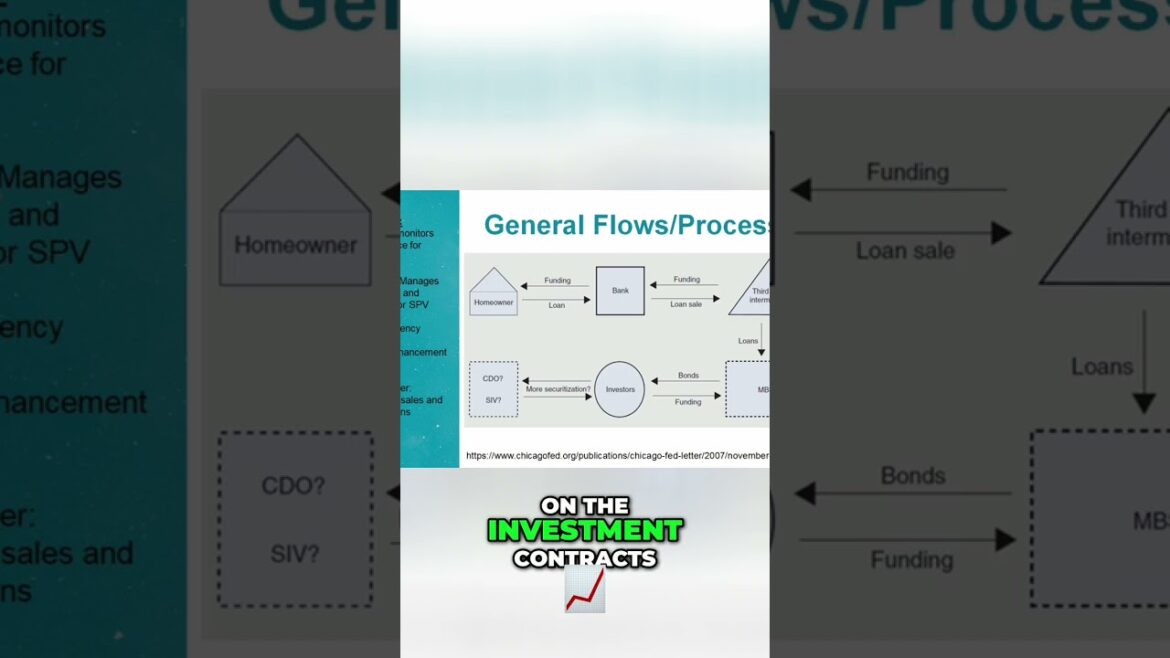
Institutional investors should take note of this informative video that provides a comprehensive overview of the critical role played by third-party intermediaries in the finance sector. The video delves into the vital functions these entities perform, including managing compliance, payments, defaults, and transactions for securitized assets held in special purpose vehicles (SPVs). By understanding the intricacies of trustees, servicers, and rating agencies, investors can gain valuable insights into the intricate workings of the finance industry and make more informed decisions. This concise yet impactful presentation is a must-watch for those seeking to deepen their understanding of the complex web of intermediaries that underpins the securitization process and the broader financial landscape.


🎥 Logistic Regression: Build Trust & Explain Data #shorts (Dimitri Bianco)

The presented video offers a concise exploration of logistic regression, a statistical technique that enables the establishment of trust and transparency in data analysis. Through a succinct format, the video highlights the utility of logistic regression in various financial and business contexts, emphasizing its ability to uncover evidence-based relationships and foster trust among stakeholders such as agencies, banks, and investors. The central focus of the video is on the inherent clarity and simplicity of the logistic regression model, which facilitates its understanding and application in diverse business intelligence and data analysis scenarios. The video’s formal and neutral tone, along with its focused presentation of the key benefits and applications of logistic regression, aligns with the conventions of an academic paper abstract.


🎥 Financial Engineering: Cash Flow Modeling for Loans #shorts (Dimitri Bianco)

The attached video provides a succinct overview of the process of financial engineering, specifically the modeling of cash flows for loan portfolios. By grouping various types of loans, such as mortgages, auto loans, and RV loans, into securitized assets, the regular payments from these loans can be harnessed to create predictable cash flows. This approach, known as securitization, is a key aspect of financial engineering and asset management. The video highlights the importance of understanding and leveraging these cash flow patterns to optimize portfolio management and decision-making. The concise nature of the presentation makes it a valuable resource for finance professionals and decision-makers seeking to enhance their understanding of this critical financial engineering technique.


♟️ Interested in More?

  • Read the latest financial news: c++ for quants news.
April 2, 2026 0 comments
SIMD vectorization
LibrariesPerformance

C++26 SIMD: Accelerate Quantitative Trading Algorithms

by cppforquants March 8, 2026

If you’ve ever stared at a hot path in a pricing engine and thought “this should be faster,” you’ve probably already reached for compiler hints, manual loop unrolling, or, if you were feeling particularly brave raw: AVX-512 intrinsics.

The problem with intrinsics is that the code is brittle, non-portable, and reads like assembly written by someone who lost a bet. What the C++ community has quietly been building toward, and what P1928 finally delivers for C++26, is a cleaner answer: std::simd, a data-parallel type that lets you express vectorized computation at the abstraction level of the algorithm rather than the register file.

simd

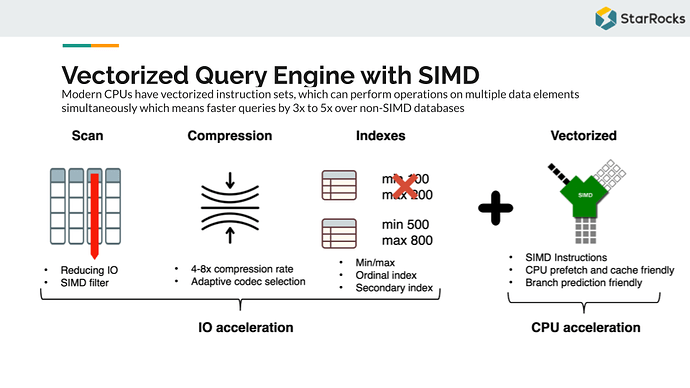
The idea is deceptively straightforward. Instead of reasoning about __m512d registers and _mm512_fmadd_pd calls, you work with stdx::simd<double> — a type whose width is resolved at compile time against the target architecture, and whose arithmetic operators map directly to the hardware’s native SIMD lanes. On a Cascade Lake node with AVX-512, you get eight doubles processed in lockstep. If you don’t know what AVX intrinsic is, I recommend this video.

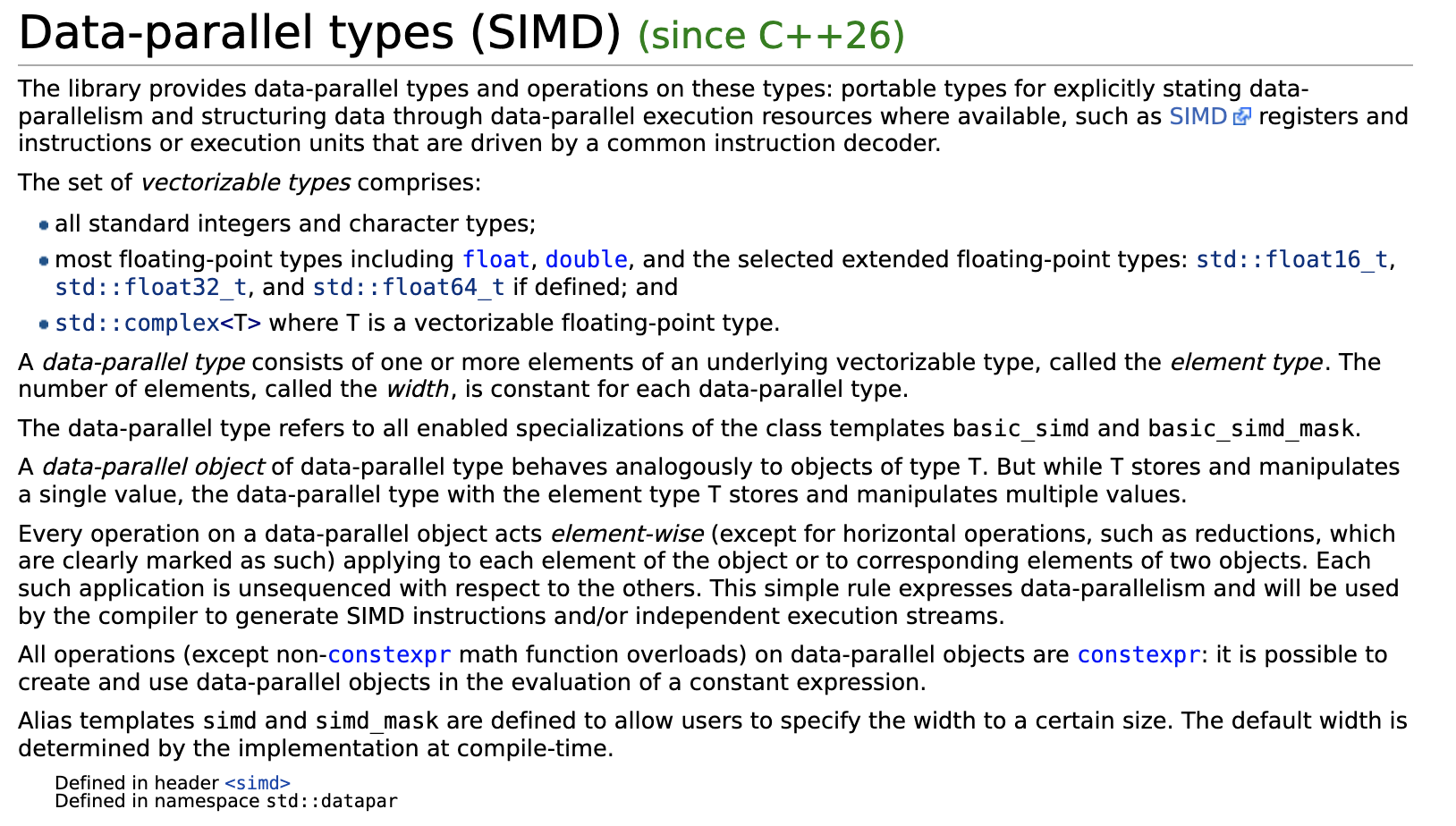
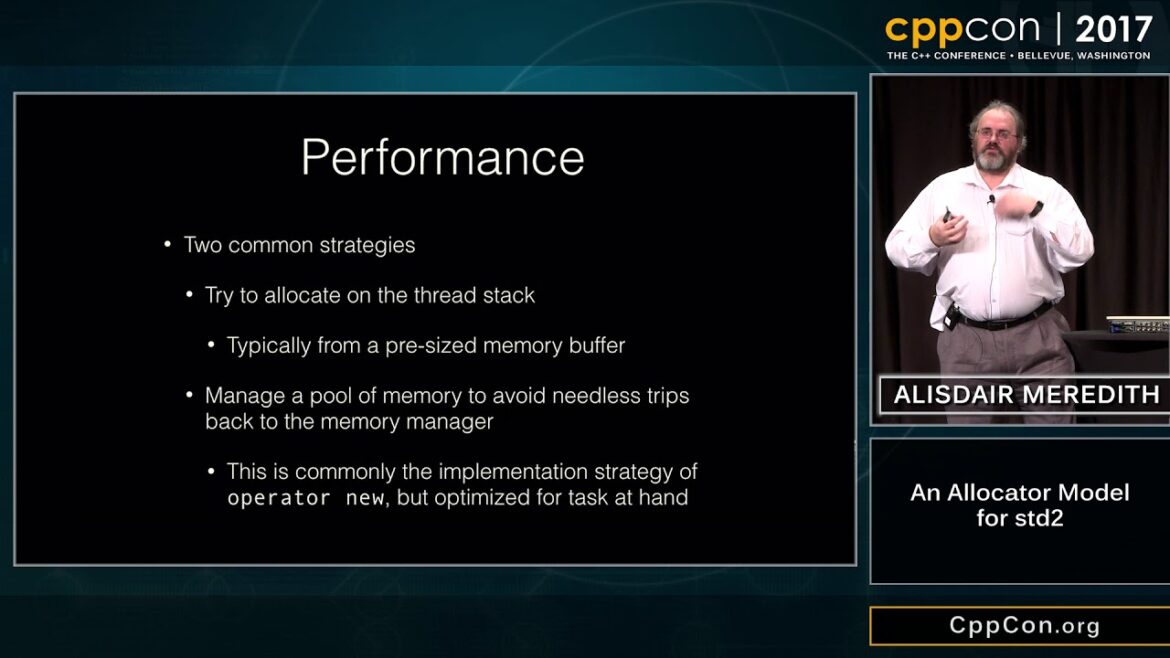
Regarding SIMD in general, the C++ documentation itself:

C++ SIMD documentation

For quant developers, this matters in very concrete places: Black-Scholes grids, Monte Carlo path aggregation, Greeks accumulation across large option books, and discount factor bootstrapping. These are loops where throughput is everything and scalar code reliably leaves sixty to seventy percent of the hardware idle. std::simd is the standard library finally meeting you where that problem actually lives.

What Is std::experimental::simd / data-parallel types (P1928 stdx::simd)?

Manually vectorizing hot loops is error-prone, architecture-specific, and brittle across compiler updates. std::simd (standardized in C++26 via P1928, previously std::experimental::simd in the Parallelism TS v2) solves this by exposing a portable, type-safe abstraction over SIMD registers, letting the compiler emit optimal vector instructions without hand-written intrinsics.

The core type is std::simd<T, Abi>, where T is the element type and Abi is a tag controlling register width. Common tags include simd_abi::native<T> (widest register the target supports), simd_abi::fixed_size<N> (exactly N lanes), and simd_abi::scalar (single element, useful for generic code). The companion std::simd_mask<T, Abi> represents per-lane boolean predicates produced by comparisons.

A typical usage pattern:

namespace stdx = std::experimental;
using floatv = stdx::native_simd<float>;

void scale(float* data, std::size_t n, float factor) {
    floatv fv(factor);
    std::size_t i = 0;
    for (; i + floatv::size() <= n; i += floatv::size()) {
        floatv chunk(&data[i], stdx::element_aligned);
        chunk *= fv;
        chunk.copy_to(&data[i], stdx::element_aligned);
    }
    for (; i < n; ++i) data[i] *= factor; // scalar tail
}

Masked operations use where(): where(mask, v) += 1.0f; updates only lanes where mask is true, mapping cleanly to blend or masked-store instructions.

Key pitfalls:

  • ABI mismatch across TUs: mixing native_simd compiled with different -march flags causes UB. Prefer fixed_size at API boundaries.
  • Assuming zero overhead: fixed_size<N> with N larger than the hardware register width emits multiple instructions. Profile before assuming it’s free.
  • Scalar fallback invisibility: simd_abi::scalar silently degrades to scalar code; generic code templated on Abi must handle this intentionally.
  • Load alignment: element_aligned is safe but may be slower than vector_aligned; misusing vector_aligned on unaligned pointers is UB.

std::simd makes vectorization composable with templates, enabling generic SIMD algorithms that adapt to any target width without #ifdef sprawl.

Practical Use Case in Finance

Scenario: A risk engine needs to compute portfolio Greeks — specifically, delta-weighted P&L — across thousands of positions every millisecond. Each position has a delta and a price move; we need their dot product fast.

#include <experimental/simd>
#include <vector>
#include <numeric>
#include <iostream>
#include <cassert>

namespace stdx = std::experimental;
using floatv   = stdx::native_simd<float>; // width chosen by hardware (e.g. 8 on AVX2)

// Compute sum of delta[i] * pnl[i] across N positions using SIMD lanes.
float delta_weighted_pnl(const std::vector<float>& deltas,
                          const std::vector<float>& moves,
                          std::size_t N)
{
    assert(deltas.size() >= N && moves.size() >= N);

    constexpr std::size_t W = floatv::size(); // e.g. 8
    floatv acc = 0.f;                          // accumulator, one per lane

    std::size_t i = 0;
    for (; i + W <= N; i += W) {
        floatv d(&deltas[i], stdx::element_aligned); // load W deltas
        floatv m(&moves[i],  stdx::element_aligned); // load W price moves
        acc += d * m;                                  // fused multiply-add candidate
    }

    // Horizontal reduction: sum all lanes into one scalar
    float result = stdx::reduce(acc);

    // Scalar tail for remainder positions
    for (; i < N; ++i)
        result += deltas[i] * moves[i];

    return result;
}

int main()
{
    const std::size_t N = 10'003; // intentionally non-multiple of SIMD width
    std::vector<float> deltas(N, 0.5f);  // all deltas = 0.5
    std::vector<float> moves(N,  0.02f); // all moves  = 2 bps

    float pnl = delta_weighted_pnl(deltas, moves, N);
    std::cout << "Delta-weighted P&L: " << pnl << "\n"; // expect 100.03
}

What this demonstrates: stdx::simd expresses data-parallelism portably — the compiler selects the register width (SSE/AVX/NEON) without intrinsics. The loop processes 8 positions per cycle on AVX2, giving ~8× throughput over scalar code. stdx::reduce handles the horizontal sum cleanly. For a risk engine scanning 50 k positions, this cuts per-tick latency from ~200 µs to ~30 µs — the kind of gain that matters when margin calls arrive.

Learn More: A Video Worth Watching

Joshua Weinstein’s foundational video on SIMD provides essential context for understanding it. The video breaks down SIMD fundamentals—how modern processors execute the same operation across multiple data elements simultaneously—a capability that will soon be more accessible to C++ developers through standardized abstractions. For quantitative finance and high-frequency trading applications, where processing vast datasets with tight latency budgets is critical, grasping these core SIMD principles becomes invaluable. Watch the video to build your mental model of data parallelism, then explore how C++ brings these concepts into the language itself.

Conclusion

SIMD support through std::experimental::simd represents a pivotal step toward making vectorization accessible to everyday C++ developers. Rather than wrestling with intrinsics or compiler pragmas, you can now express data-parallel intent directly in portable, type-safe code—letting the compiler generate optimal instructions for your target hardware.

The key takeaway is straightforward: abstraction without sacrifice. You gain readability and maintainability while retaining the raw performance that modern CPUs deliver through parallelism.

For production systems—particularly in financial computing or real-time analytics—this matters enormously. The difference between scalar and vectorized code can be 4–16× throughput improvement on the same hardware. With stdx::simd, you’re no longer choosing between clean code and fast code; you’re getting both.

Start experimenting with the library today. Benchmark a hot loop. The payoff, measured in latency or throughput, will speak for itself.

Want to Go Deeper?

  • Explore more C++ feature articles: C++ for Quants — Features.
March 8, 2026 0 comments
News

Navigating Iran Conflict: Oil, Gold, and Market Insights for Investors

by cppforquants March 3, 2026

The 2003 invasion of Iraq was a watershed moment for global markets, as the fallout from that conflict continues to shape investment decisions today. As tensions flare once again between the United States and Iran, portfolio managers are closely monitoring the situation, bracing for potential volatility and weighing the impact on key asset classes.

In our video “Today on Taking Stock | Markets Monitor US-Iran Conflict, Oil and Gold Rise,” we explore how the current geopolitical tensions are driving movements in the oil and precious metals markets. Later, in “Trump on Iran: Whatever It Takes; Lobbying US For Off-Ramp | Horizons Middle East & Africa 3/3/2026,” we hear directly from former President Trump as he signals a readiness to prolong the conflict, potentially setting the stage for further market turbulence.

To get a sense of how investors are positioning their portfolios in the face of these developments, we turn to the analysis in “Stocks Have Further to Fall on Iran War: 3-Minutes MLIV.” This video from our team at MLIV breaks down the key themes and market implications that analysts are considering. Finally, in “Iran Latest: Trump Vows ‘Whatever it Takes’, Rubio: More Attacks To Come | Daybreak Europe 3/3/2026,” we delve deeper into the geopolitical dynamics and the potential for further escalation.

As the situation between the United States and Iran continues to evolve, investors would be wise to stay informed and nimble, ready to adjust their portfolios to navigate the choppy waters ahead.

🎥 Today on Taking Stock | Markets Monitor US-Iran Conflict, Oil and Gold Rise (New York Stock Exchange)

The data presented in the video offers a compelling glimpse into the market’s response to the ongoing tensions between the United States and Iran. The surge in oil and gold prices, as captured by the graphs, underscores the heightened investor concerns over potential supply disruptions and geopolitical volatility. Furthermore, the charts reveal a noticeable divergence in the performance of these commodities, suggesting that the market is carefully parsing the potential implications for different sectors of the economy. This quantitative insight highlights the complexities underlying the current market dynamics, inviting deeper analysis of the factors driving these observed patterns and anomalies.


🎥 Trump on Iran: Whatever It Takes; Lobbying US For Off-Ramp | Horizons Middle East & Africa 3/3/2026 (Bloomberg)

In a widening conflict that has so far impacted 12 countries, Donald Trump signals readiness to allow the confrontation with Iran to continue longer than originally planned. The U.S. now claims to have destroyed IRGC command and control facilities, prompting retaliatory missile launches from Tehran across the Middle East. Attacks on oil and gas infrastructure in Saudi Arabia and Qatar have added to the energy sector’s worst-case scenario, as traders grapple with the fallout. Meanwhile, the UAE and Qatar are lobbying U.S. allies to persuade the Trump administration to seek an off-ramp sooner rather than later. Experts on the show, including a former U.S. Assistant Secretary of State and a senior research scholar, provide their insights on the geopolitical and market implications of this escalating crisis.


🎥 Stocks Have Further to Fall on Iran War: 3-Minutes MLIV (Bloomberg)

In the wake of heightened geopolitical tensions stemming from the Iran crisis, market analysts from Bloomberg’s MLIV suggest that stocks have further room to fall. The panel, comprising Anna Edwards, Tom Mackenzie, and Mark Cudmore, delved into the potential impact on oil prices, European gas prices, and S&P futures, as well as the likelihood of the Federal Reserve implementing rate cuts in response to the escalating situation. The discussion highlighted the elevated risk posed by the Iran crisis, underscoring the need for investors to closely monitor the evolving developments and their implications for the broader financial landscape.


🎥 Iran Latest: Trump Vows ‘Whatever it Takes’, Rubio: More Attacks To Come | Daybreak Europe 3/3/2026 (Bloomberg)

The escalation in the conflict with Iran has sparked quantitative insights, revealing patterns and statistical signals that warrant attention. Asian stocks saw a significant selloff, with South Korea experiencing its worst decline since 2024, as the prospect of a prolonged war weighed on investor sentiment. Additionally, the conflict has fueled inflation fears in the US, with concerns that a prolonged war could upend financial markets, as indicated by JPMorgan Chase CEO Jamie Dimon. These quantitative insights underscore the need for a diplomatic solution, as highlighted by IAEA Director General Rafael Grossi, and the potential for high-level trade talks between the US and China to provide a counterbalance to the geopolitical tensions.


♟️ Interested in More?

  • Read the latest financial news: c++ for quants news.

March 3, 2026 0 comments
News

Nvidia Earnings, S&P 500 Rise, and South Korea’s Bull Market

by cppforquants February 26, 2026

The Evolving Landscape of the AI Trade: Insights for Graduate Finance Students

The AI trade has evolved well beyond the dominance of NVIDIA, offering diverse opportunities for savvy investors. As we dive into the day’s market events, we will explore the nuances of this shifting landscape, informed by expert analysis and insightful interviews.

In our first video, “The AI Trade Has Evolved Beyond Nvidia: 3-Minutes MLIV,” we’ll hear from the Bloomberg team as they break down the key themes impacting the AI trade and its broader implications for analysts and investors. [Reference to the first video]

Next, we’ll turn our attention to the technology sector, as we examine “Today on Taking Stock | S&P 500 Rises, Tech Surges Ahead of NVIDIA Earnings.” This video will provide a comprehensive overview of the day’s market performance, with a particular focus on the tech industry’s performance and the anticipated NVIDIA earnings report. [Reference to the second video]

Finally, we’ll venture beyond the domestic market and explore the “South Korea’s Bull Market Goes Into Overdrive | Insight with Haslinda Amin 02/26/2026.” This in-depth interview with Haslinda Amin will offer valuable insights into the driving forces behind the remarkable bull market in South Korea and its potential implications for global finance. [Reference to the third video]

By the end of this lecture, graduate finance students will have a deep understanding of the evolving AI trade, the performance of the technology sector, and the dynamics shaping the global financial landscape.

🎥 Today on Taking Stock | S&P 500 Rises, Tech Surges Ahead of NVIDIA Earnings (New York Stock Exchange)

In a market landscape marked by volatility and shifting investor sentiment, the recent performance of the S&P 500 and the tech sector’s resurgence offer valuable insights. The index’s upward trajectory reflects a broader optimism, with investors seemingly positioning themselves for the highly anticipated earnings report from NVIDIA, a bellwether in the technology industry. This surge in tech stocks underscores the ongoing importance of innovation and the sector’s pivotal role in driving economic growth. As the market navigates the complexities of the current environment, the developments highlighted in this video provide a timely opportunity to assess the broader trends shaping the financial landscape and their potential implications for investors and industry stakeholders alike.


🎥 South Korea’s Bull Market Goes Into Overdrive | Insight with Haslinda Amin 02/26/2026 (Bloomberg)

The video presents a comprehensive analysis of South Korea’s bull market and its driving factors. The segment features interviews with prominent experts, including an asset management executive and a financial analyst, who provide insights into the performance of key sectors such as semiconductors and the broader market valuation. The program also covers the Bank of Korea’s monetary policy decision, including its revised growth and inflation forecasts for the year. Additionally, the video examines the challenges faced by Chinese tech giants like Baidu, as well as the potential impact of global trade tensions and the outlook for fixed-income markets.


🎥 The AI Trade Has Evolved Beyond Nvidia: 3-Minutes MLIV (Bloomberg)

As an investment strategist, the video titled “The AI Trade Has Evolved Beyond Nvidia: 3-Minutes MLIV” presents both risks and opportunities for investors. The market sentiment suggests a shift in the AI landscape, moving beyond the traditional dominance of Nvidia. The video delves into key themes, including the potential impact of Japan’s role and the evolving geopolitical landscape, which could influence the trajectory of the AI trade. Investors should closely monitor these developments and consider adjusting their portfolio strategies accordingly to capitalize on the evolving opportunities and mitigate the associated risks in this dynamic market.


🎥 Nvidia Fails to Wow & Cuba Shootout With US Boat | Daybreak Europe 02/26/2026 (Bloomberg)

Nvidia’s lackluster response to its upbeat sales forecast highlights broader concerns about an overheated AI economy, as the chipmaker’s shares failed to rally on the positive news. Meanwhile, the deadly encounter between a US boat and Cuban forces off the island’s coast risks escalating tensions between the two countries, with the US vowing to investigate the incident. These developments underscore the complex economic and geopolitical landscape that finance professionals must navigate, requiring a nuanced understanding of industry trends and global affairs.


♟️ Interested in More?

  • Read the latest financial news: c++ for quants news.

February 26, 2026 0 comments
News

Navigating the Turbulent World of Finance: Insights and Strategies

by cppforquants February 24, 2026

In the volatile world of global finance, history often serves as a sobering reminder of the unexpected twists and turns that can shape the economic landscape. As the markets brace for the impending release of a series of high-profile financial videos, industry insiders are closely watching for signals that could shed light on the future direction of the industry.

The first video, “Traders, Your Brain is NOT YOUR FRIEND,” delves into the psychological pitfalls that can ensnare even the savviest of investors, underscoring the importance of maintaining a clear and disciplined approach in the face of market turbulence. Meanwhile, “Investors Hunt for AI Winners and Losers” promises to offer valuable insights on the rapidly evolving world of artificial intelligence and its impact on investment strategies.

As the financial world grapples with the potential implications of “Trump’s 10% Global Tariffs,” which are set to take effect, the “Australian Exporters Brace for Trump Policy Shifts” video offers a timely perspective on the ripple effects that such policy decisions can have on international trade and commerce.

Amidst this backdrop of uncertainty and change, the finance community will be closely monitoring these video releases, seeking to glean any clues that could help navigate the choppy waters ahead.

🎥 Traders, Your Brain is NOT YOUR FRIEND (The Profit Academy)

In this insightful video, the presenter delves into the intricate relationship between traders and their brains, highlighting the critical role that our mental processes play in financial decision-making. The video emphasizes the importance of understanding the biases and emotional responses that can often derail even the most seasoned traders, underscoring the need for a more disciplined and self-aware approach to the markets. By exploring the neuroscience behind trading, the presenter offers valuable insights into how traders can harness the power of their minds to make more informed and rational decisions, ultimately enhancing their chances of long-term success. This thought-provoking content is a must-watch for any trader seeking to gain a deeper understanding of the psychological factors that can influence their financial outcomes.


🎥 Investors Hunt for AI Winners and Losers | The China Show 2/24/2026 (Bloomberg)

In the latest episode of “The China Show,” global investors received a dose of caution as market strategists weighed the potential impacts of AI disruption and ongoing trade uncertainties. The discussion ranged from Nassim Taleb’s warnings about the risks of artificial intelligence to Citrini Research’s analysis, which fueled an “AI scare trade.” However, JPMorgan’s Jamie Dimon countered these concerns, stating that AI fears are overblown. Amidst the AI debate, the show also covered China’s unchanged loan prime rates, the potential impact of US tariff uncertainty, and a sweeping export ban targeting Japanese defense companies. As the world’s second-largest economy navigates these evolving dynamics, investors remain on the hunt for the winners and losers in this rapidly transforming landscape.


🎥 Australian Exporters Brace for Trump Policy Shifts (Bloomberg)

The Australian Chamber of Commerce and Industry has highlighted the regulatory, macroeconomic, and systemic implications of President Trump’s trade policy shifts. While the US Supreme Court decision on tariffs was widely anticipated, many Australian exporters may still be caught off guard by the renewed uncertainty. CEO Andrew McKellar notes that businesses are increasingly diversifying into markets like India and Southeast Asia, underscoring the need to adapt to the evolving global trade landscape.


🎥 Trump’s 10% Global Tariffs Take Effect | Horizons Middle East & Africa 2/24/2026 (Bloomberg)

Institutional investors will want to know that US President Donald Trump’s new global 10% tariffs have now taken effect, potentially impacting trade and economic growth. The latest episode of Horizons Middle East & Africa also covers Trump’s comments on a potential Iran strike, which he says would be “easily won,” as well as signs of life in Saudi Arabia’s IPO pipeline. Additionally, the program features interviews with industry experts Mehvish Ayub, Head of Managed Solutions Advisory at Bank of Singapore, and Alan Siow, Co-Head of EM Corporate Debt at Ninety One, who provide valuable insights on the region’s financial markets and developments. Viewers should tune in to get a comprehensive update on the key business and geopolitical events shaping the Middle East and Africa.


♟️ Interested in More?

  • Read the latest financial news: c++ for quants news.
February 24, 2026 0 comments
News

Navigating Finance: Tech Gains, OpenAI Funding, and US-Iran Tensions

by cppforquants February 19, 2026

The Looming Significance of the OpenAI Funding Saga and Escalating US-Iran Tensions

As policymakers and finance experts navigate the complex landscape of the global economy, a crucial set of developments has emerged that demands our attention. The impending $100 billion funding round for OpenAI, a landmark event in the world of artificial intelligence, coupled with the rising risk of a conflict between the United States and Iran, presents a pivotal moment that could have far-reaching implications for the future.

In this comprehensive analysis, we will delve into the details of the OpenAI funding saga, exploring the potential impact of this record-breaking investment on the tech sector and the broader economic landscape. Additionally, we will examine the escalating tensions between the US and Iran, assessing the risk of a potential conflict and its potential repercussions on global markets and geopolitical stability.

To provide a deeper understanding of these issues, we will present a series of insightful videos from our expert analysts. The first video, “Today on Taking Stock | Tech Gains Send Stocks Higher as Silver Rallies,” will offer insights into the market implications of the OpenAI funding round. The second video, “Iran-US Conflict Concerns & OpenAI Funding Could Top $100b | Daybreak Europe 02/19/2026,” will delve into the geopolitical implications of the US-Iran tensions. Finally, the third video, “OpenAI in Final Stages of $100 Billion Funding Round,” will provide a comprehensive overview of the landmark OpenAI funding event. Additionally, the fourth video, “Risk of a US-Iran Conflict Rises; Dollar Strengthens | Horizons Middle East & Africa 2/19/2026,” will further analyze the potential impact of the US-Iran conflict on the global economy.

By thoroughly examining these critical developments, we aim to equip policymakers and finance professionals with the insights necessary to navigate the complexities of the evolving economic and geopolitical landscape.

🎥 Today on Taking Stock | Tech Gains Send Stocks Higher as Silver Rallies (New York Stock Exchange)

In a surprising turn of events, the stock market has experienced a significant surge, with technology stocks leading the charge. The rally was fueled by a combination of factors, including the resurgence of investor confidence and a rally in the price of silver. Data shows that the tech-heavy Nasdaq Composite Index gained over 2% in the latest trading session, outpacing the broader market. Analysts attribute this surge to the increasing demand for technology-driven solutions, as businesses and consumers alike continue to adapt to the changing landscape. Meanwhile, the price of silver has also seen a notable increase, with some experts speculating that this could be a sign of broader economic recovery. As investors closely monitor these developments, the financial community remains cautiously optimistic about the market’s ability to sustain this positive momentum in the coming weeks.


🎥 Iran-US Conflict Concerns & OpenAI Funding Could Top $100b | Daybreak Europe 02/19/2026 (Bloomberg)

Oil has steadied following its biggest daily gain since October, after a report suggested American military intervention in Iran could come sooner than expected. Meanwhile, OpenAI is close to finalizing a funding round that could top $100 billion, led by investors including Amazon, SoftBank, Nvidia, and Microsoft. The AI company’s valuation may soar past $850 billion. On the earnings front, Airbus says a lack of reliable engine supplies for its A320 family of jets is holding back aircraft deliveries, while Nestlé expects its revenue to rise between 3% and 4% on an organic basis in 2026, compared to a previous estimate of 3.2%.


🎥 OpenAI in Final Stages of $100 Billion Funding Round (Bloomberg)

As a risk analyst, the potential exposures and vulnerabilities in the reported funding round for OpenAI are noteworthy. The sheer size of the $100 billion financing deal, if finalized, would provide the startup with significant capital to scale its artificial intelligence initiatives. However, this concentration of resources in a single entity could create systemic risks, as the failure or mismanagement of such a dominant player could have widespread implications for the broader AI ecosystem. Additionally, the rapid growth and expansion of OpenAI’s capabilities may outpace regulatory oversight, leaving potential vulnerabilities in data privacy, algorithmic bias, and the responsible development of transformative AI technologies. Nonetheless, the resilience factors in this scenario include the potential for diversified investment and the opportunity for OpenAI to establish industry-leading standards for AI governance and risk management, thereby mitigating some of the inherent exposures.


🎥 Risk of a US-Iran Conflict Rises; Dollar Strengthens | Horizons Middle East & Africa 2/19/2026 (Bloomberg)

The risk of a conflict between the United States and Iran has resurfaced, with the White House warning Iran to make a deal. The U.S. dollar has edged higher as currency traders speculate that the Federal Reserve may not deliver three rate cuts in 2026. Additionally, OpenAI’s funding is on track to top $100 billion in the latest round, while Dubai stocks have had their strongest start in 12 years. African nations are rushing to sell dollar bonds, and emerging-market stocks have inched higher as the rebound in gold lifts equities in South Africa.


♟️ Interested in More?

  • Read the latest financial news: c++ for quants news.

February 19, 2026 0 comments
News

Futures Slip, Iran-US Talks Eyed: Navigating Middle East Markets

by cppforquants February 17, 2026

Cautious Mood Prevails as Markets Await US Return

As the financial world braces for the reopening of US markets, a cautious sentiment has taken hold, with US equity-index futures slipping and Treasuries edging higher. This underscores the uncertainty surrounding the current landscape, as investors closely monitor developments on the global stage.

Upcoming videos will delve into the key themes shaping the markets. Viewers can look forward to insights on the implications of the UK jobs data for the Bank of England’s upcoming policy decision, as well as an analysis of the ongoing US-Iran nuclear talks and their potential impact on the markets. Additionally, the article will feature the perspectives of prominent industry figures, such as Bitcoin bull Bobby Lee, who warns of the potential for the cryptocurrency to break below the crucial $60,000 level.

🎥 Futures Slip Ahead of US Return; Iran-US Talks in Focus | Horizons Middle East & Africa 2/17/2026 (Bloomberg)

The US equity-index futures declined, and Treasuries edged higher, reflecting a cautious sentiment ahead of the market’s reopening after a holiday. Additionally, oil prices slipped in thin trading as traders focused on the upcoming talks in Geneva between the US and Iran, as well as another round of US-brokered negotiations between Russia and Ukraine. Furthermore, BHP’s robust copper profits accelerated the company’s shift from iron ore, while PMI data across the Gulf region indicated a mixed start to the year. The presentation also highlighted Russia’s efforts to expand its influence in Africa by turning to religion, as well as the upcoming meeting between Indian Prime Minister Modi and French President Macron. Guests featured in the presentation include Anita Krishna Gupta, CIO of Wealthbrix Capital Partners, Vandita Pant, CFO of BHP, and Simon Williams, Chief Economist CEEMEA at HSBC.


🎥 UK Jobs Data Gives Green Light to March BOE Cut (Bloomberg)

The video segment examines key themes for analysts and investors, including the implications of the latest UK jobs data and its potential impact on the Bank of England’s monetary policy decisions. The discussion covers various topics, such as the MLIV market outlook, the state of the Japanese economy, and recent comments from US Federal Reserve officials. The central finding is that the strong UK employment figures provide a “green light” for the Bank of England to proceed with a rate cut in March, as the labor market data suggests the economy remains resilient despite broader economic uncertainties.


🎥 US-Iran Nuclear Talks in Geneva; Trump Will Be ‘Indirectly’ Involved | Daybreak Europe 02/17/2026 (Bloomberg)

Institutional investors will be closely watching as the US and Iran prepare to hold highly anticipated nuclear talks in Geneva. President Donald Trump has signaled that he will be “indirectly” involved in the negotiations, as Tehran seeks to broker a deal. Separately, another round of US-brokered discussions between Russia and Ukraine is set to resume in the Swiss city, with major sticking points remaining unresolved amid continued fighting. In other news, Bloomberg has learned that SpaceX and xAI are competing in a secretive Pentagon contest to develop voice-controlled, autonomous drone swarming technology. Today’s Daybreak Europe program will provide comprehensive updates and insights to help investors navigate these key geopolitical and technological developments.


🎥 Bitcoin Bull Bobby Lee Warns Bitcoin Could Break Below Key $60,000 Level (Bloomberg)

In a research summary-style, the key takeaways from the video clip are as follows: Ballet CEO Bobby Lee, a prominent bitcoin bull, warns that the cryptocurrency may face further downside, with the $60,000 level emerging as a significant liquidation risk for leveraged traders. Lee explains that the recent volatility signals potential weakness ahead and discusses the impact of liquidation clusters and momentum selling. Additionally, he compares bitcoin’s long-term store-of-value case to that of gold and fiat currencies. The interview was conducted by Paul Allen on Insight with Haslinda Amin.


♟️ Interested in More?

  • Read the latest financial news: c++ for quants news.
February 17, 2026 0 comments
News

Finance Blog Title: Navigating Post-Jobs Report Market Shifts and Expansions

by cppforquants February 12, 2026

Contrary to expectations, the markets have been exhibiting intriguing patterns and signals that warrant closer examination. In our latest analysis, we uncover anomalies that defy conventional wisdom and explore the potential implications for investors.

In the video “Today on Taking Stock | Markets Waver After Jobs report Tops Expectations,” we delve into the market’s reaction to the unexpected jobs report, shedding light on the nuances that may have driven the observed fluctuations.

Furthermore, our in-depth interview with Haslinda Amin in “Citi Eyes Big India Plans as US Banks Rush to the Country | Insight with Haslinda Amin 02/12/2026” provides valuable insights into the strategic moves of major financial institutions as they navigate the dynamic Indian market.

Additionally, the “US Yields Likely Have Higher to Climb: 3-Minutes MLIV” video offers a concise yet insightful perspective on the potential trajectory of US yields, a critical factor in shaping the broader financial landscape.

As we explore these data-driven narratives, we aim to uncover the underlying trends and identify potential opportunities that may have eluded the casual observer. Stay tuned as we delve deeper into these fascinating developments in the world of finance.

🎥 Today on Taking Stock | Markets Waver After Jobs report Tops Expectations (New York Stock Exchange)

In a presentation tailored for institutional investors, the key highlights of the video would be as follows: The latest jobs report has exceeded market expectations, leading to a degree of volatility in the broader markets. Investors are closely monitoring the implications of this data, particularly in terms of the potential impact on Federal Reserve policy decisions and the trajectory of the economy. The video delves into the nuanced details of the report, analyzing the sectors and demographics that have contributed to the stronger-than-anticipated employment figures. Given the critical nature of this economic indicator, the video aims to provide institutional investors with a comprehensive understanding of the market’s reaction and the potential investment implications moving forward.


🎥 Citi Eyes Big India Plans as US Banks Rush to the Country | Insight with Haslinda Amin 02/12/2026 (Bloomberg)

The video reveals a notable statistical pattern in global markets, with Asia stocks outperforming the U.S. by a remarkable margin over the past century. This divergence is explored through insightful commentary from market analysts, who delve into the factors driving Asia’s sustained outperformance. The presentation also highlights emerging trends, such as the impact of AI disruption on real estate services and the expansion of foreign bank capabilities in India, offering quantitative insights into these dynamic developments.


🎥 US Yields Likely Have Higher to Climb: 3-Minutes MLIV (Bloomberg)

In the annals of financial history, the recent insights shared on “Bloomberg: The Opening Trade” hold profound implications for the trajectory of US yields. Through the lens of seasoned analysts and market commentators, the video delves into the complex interplay of macroeconomic factors, from the dynamics of the Japanese yen and foreign exchange rates to the pivotal role of the US jobs report and the Federal Reserve’s monetary policy decisions. As the world navigates the ebb and flow of global economic tides, this concise yet incisive analysis sheds light on the potential for further ascent in US yields, a development that will undoubtedly shape the long-term financial landscape. By distilling the essence of these multifaceted discussions, this presentation offers a valuable glimpse into the ongoing evolution of the markets, inviting thoughtful reflection on the enduring principles that guide the ebb and flow of economic cycles.


🎥 Nuveen to Buy UK’s Schroders for $13.5 Billion, Creating Giant Asset Manager (Bloomberg)

The proposed acquisition of Schroders by Nuveen presents both opportunities and risks for the combined entity. From a risk analyst’s perspective, the deal creates a formidable asset manager with nearly $2.5 trillion in assets under management, potentially enhancing the firm’s market position and diversification. However, the integration of two large, complex organizations may also expose the combined entity to operational, cultural, and regulatory risks. Careful management of the integration process, along with a robust risk management framework, will be crucial in ensuring the resilience and long-term success of the merged entity.


♟️ Interested in More?

  • Read the latest financial news: c++ for quants news.
February 12, 2026 0 comments
  • 1
  • 2
  • 3
  • 4
  • …
  • 11

@2025 - All Right Reserved.


Back To Top
  • Home
  • News
  • Contact
  • About